A Ramble in the Andrews
“Here’s where the water sheds.”
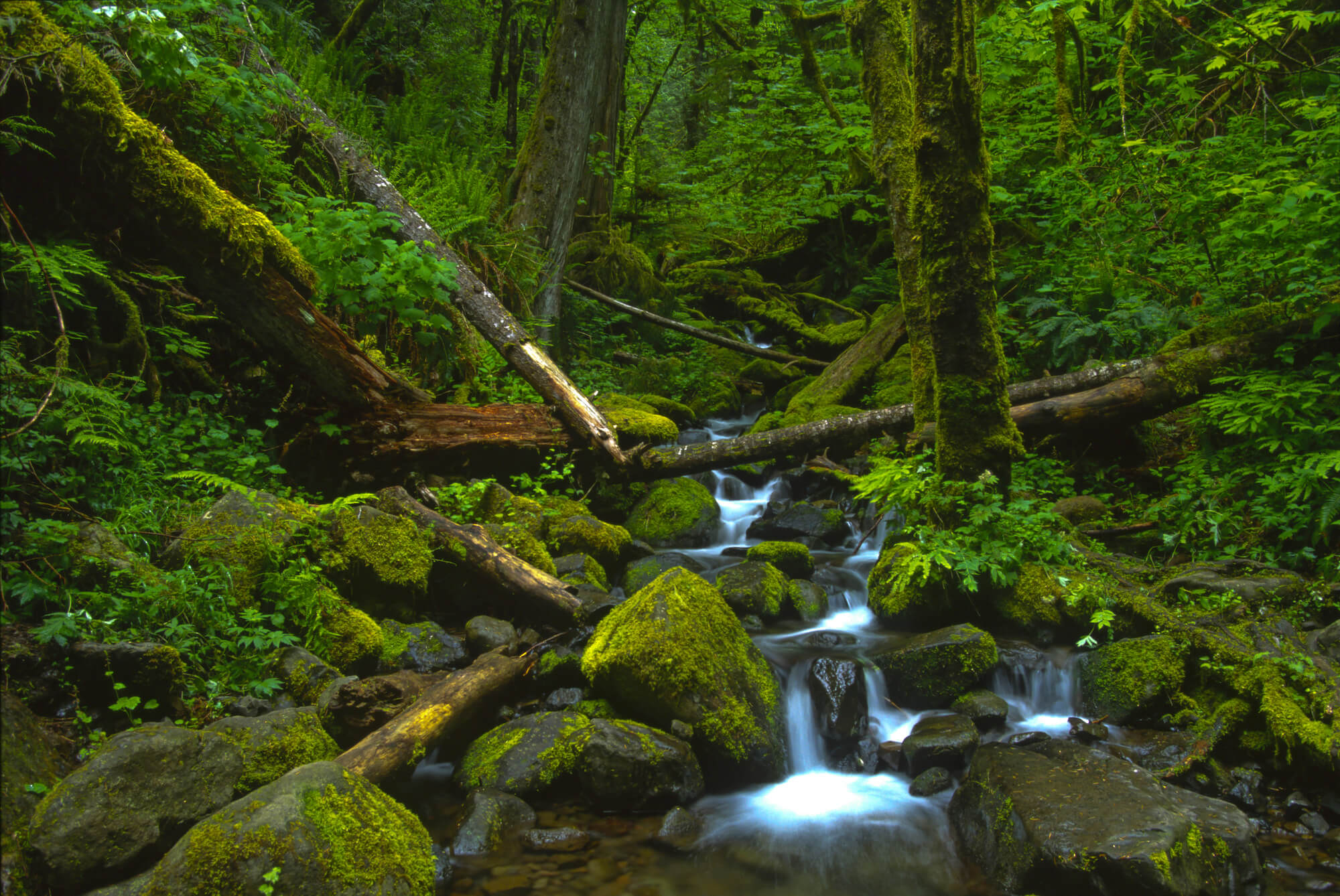
As part of his job in the Long‐Term Ecological Research program, Fred Swanson hauls poets and writers around the H.J. Andrews Experimental Forest and says things like that. Today he’s also brought along the Andrews’ new site director, Mark Schulze, who oversees this 16,000‐acre operation. At the foot of Watershed 10, a very steep V in a ridge above Blue River, we get out of the van and walk up to a little shed perched on the steep incline. A forceful stream of water spills down the slope and rushes past us.
I’m standing in the morning rain soaking up facts. Under the eave of the little gauging station Mark looks up the slope as Fred describes what it was like here in the winter of ’96. Knowing the mountain was saturated and about to collapse, he was here to witness this geomorphologist’s dream event. Fred loves disturbance. His descriptions are animated by the memory of seeing the mountain let loose, first from one fork, then the other, a slide of big boulders from up that way, mud and trees slipping down over there, all of it sloshing and rumbling down to where we’re standing, taking out the gauging shed and burying the concrete spillway, then slurping across the road and out into a wide alluvial fan. The three of us standing here, daring it to do it again.
A watershed is a verb.
I’ve come to the Andrews with a project I’ve been working on, something I call a watershed opera—which is truly odd, because I know almost nothing about opera and rely entirely on people like Fred for the most rudimentary understanding of watersheds. The project emerges not so much from having something to say, as simply having to say something. The little coastal valley where I live includes in its upper reaches the famous Headwaters Forest, bought by the government from the Texas junk bond king who’d been clearcutting its old growth redwoods for twenty years. Now it’s the site of hiking trails and restoration projects. A few Coho have been seen returning.
But there’s another fork of the river with less famous headwaters, thousands of acres of logged‐over forest that didn’t get preserved. They are being logged again by their new owners, who promise better practices but have a big payroll and huge debt to service. How to tell people who think the Headwaters issue is over: It’s not. To get them to see the sorry condition of our watershed. To understand that a watershed is something we live in. Something salmon might live in if the river wasn’t choked with silt. How to begin the kind of conversation we’re having now, standing in the rain in Oregon.
What do we talk about when we talk about watersheds? Is it the ridge line, where water is literally shed one way or the other, a divide and bioregional boundary? Or is it everything inside the boundary, as John Wesley Powell’s “that area of land, a bounded hydrologic system, within which all living things are inextricably linked by their common water course and where, as humans settled, simple logic demanded that they become part of a community.” Maybe all we’re missing at home is that simple logic.
But as we’ve just witnessed, a watershed is also a process of shedding, including things more solid than water, and some things less. Last year when I was here Fred took a group of writers to a little ravine where instruments measure the flow of air currents up and down the mountain. And in the van, on the way to our next site, he mentions that owls prefer to hunt away from the “noise” of creeks, which along with the wind in mountain pines is my favorite music. So it’s also an air and sound shed. And then there’s the flow of sun and shadow over slope and mountain contour, a kind of light shed. And drifting through all these relations, the shed of mind, of our roving inquiry.
What would a poet say about these things? How does this fit into your opera? What made you say that? Were you around for the Redwood Park wars? A watershed is the shaping of Fred’s questions.
At the alluvial base of Watershed 10, where the road now cuts through and reveals its cross‐section, the ’96 slide is just the most recent layer in ages of mountain shaping. Halfway up the cut there’s a thin yellow strip, the remnant of 7,000‐year‐ago volcanic debris, another mountain’s contribution to this one, which it then shed. The questions have been forming themselves for a long time.
We climb out of the van again, walk down a short trail to Blue River. True to its name, flowing clear and deep over cobbled stone, a prime salmonid stream—except for the dam a few miles downriver, and others below where it joins the McKenzie. Three pipes inserted into a deep pool monitor its flow so the Army Corp of Engineers can regulate the water level in Blue River Reservoir and thus provide flood control and reliable summer supplies to downstream cities and farms. No questions here. The Corps delivers answers. Dams provides short‐term certainty.
Back in the van our conversation slows, then revives. Fred knows that my occupational history includes a couple of decades of wood butchery. “How do you feel about all this from a carpenter’s point of view?” The old adage, Measure twice, cut once comes to mind. “Don’t waste materials,” I say. No trophy homes, no flake‐board housing. Most of my jobs were repair and remodel, and even included some creek restoration, so in some measure my labor has been part of the conversation with watershed. But there was also a lot of sheetrock and what’s known in the trade as mud.
Up Tidbits Creek, just beyond the Andrews boundary, we stop along a mountainside road, get out and look back across Blue River. Cloud and rain and fog obscure the view. “Not a good day,” says Fred. Then, surveying the storm‐swept mountains, always attentive to accuracy: “Well, it’s a good day, but not for this.” We walk around a bend and up the road, gaze out to where several definitions of watershed compete.
Fred points to sections of forest while he recounts the brief and turbulent history of industrial forestry. Over there we see where the cutting left selected stands of fir, a practice he and Jerry Franklin and others have advocated since the 80’s. And over there is management for species, as in the spotted owl wars and the Northwest Forestry Plan, and now the possibility of shooting barred owls because they’re crowding out their endangered cousins. Or over there, that slope is managed with periodic fire, a practice based on research like Fred’s into natural disturbances and recovery. Or as he puts it, “the way nature knocks things around.”
I ask Fred about the remnant stands of older trees, and once he points them out I’m surprised how easily they’re distinguished from the surrounding industrial definition of forest, monoculture fir plantations just beginning to be diversified by landslide and disease and the thousand events and interactions that we call watershed. Where certainties become questions, and the ongoing responses are called adaptive management.
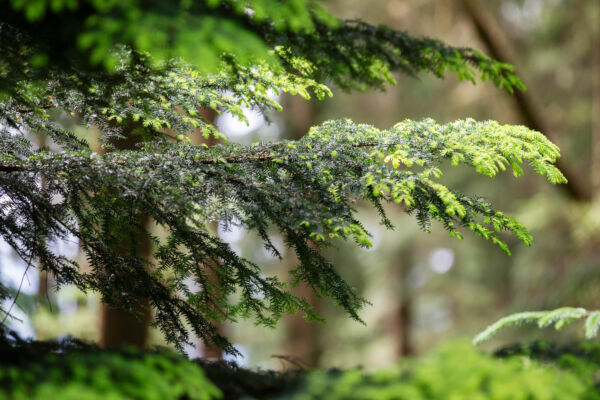
Walking in the Log Decomp site is comparatively peaceful, like a visit home—a scary thought given my morbid associations with the place. Looking down at the rain‐soaked mosses I wonder if Fred will really ask me to lie down, as he proposed, while I read a poem about this 200‐year experiment in decay. I picture Dracula coming back to his crypt before dawn, folding into his moldy box. Closing it. But Fred doesn’t mention the idea again, so while he films I stand and read Return of the Dead Log People to the lichen‐draped yew and Douglas fir and the logs rotting around us. I’m conscious of giving off poetry gas, the performance another kind of decomposition. I wonder if the trees can separate the words from the CO2. All the while the active poem, the dramatic poem, the three of us talking, joking, querying and replying, moves from place to place, opening to passages in the landscape. Maybe it’s watershed opera.
Neither Fred nor Mark are sure what DIRT stands for‐‐Detritus something‐‐but the site lives up to its acronym. Black plastic, white pvc, scientific apparatus here and there, it’s downright trashy. But Mark describes findings from these humble experiments, this gloomy forest burial ground, that may be the most urgent news of our day in the woods: what does it mean that increased amounts of duff on the forest floor hastens the decay process? And thereby changes our calculations for CO2? Uh‐oh. Recalculate climate change.
We’re somber and quiet as we leave the site, walking through the dripping forest single file. I recall a scene from an early Thomas Hardy novel, The Woodlanders. It’s predictable romantic stuff, but provides a valuable picture of a rural life that Hardy saw passing away. The heroine’s father manages a forest, a wooded commons. When someone wants to build a house they go for a walk in the woods with the forester, select suitable trees, agree on terms, and the trees are felled and the lumber delivered. Like our ramble, a walk with an old agenda.
When our species left the forest, because now we could walk or run and use tools, it must have been a very gradual departure, with frequent visits back to the old home. We would go there for suitable materials for tools. The yews we’ve seen look too twisty and gnarled to make bows, but for millennia that provided a reason to walk in the woods. As did basket materials. And herbal remedies. Ship builders chose mast and keel, trees with the desired qualities of strength and flexibility. The forest was medicine chest, lumber yard. Tool shed.
Back in the van our conversation turns to our larger condition, and the diminishing prospect for remedies. A new nominee for Under‐Secretary of Agriculture (and potentially the Andrews’ new boss), is a guy with no experience in the woods. At least in this he’s representative of his fellow citizens, who are the stewards of more than they know. My opera would attempt to address this ignorance, including my own, but it’s already so burdened by editorial content it’s deteriorating into propaganda. I want it to waken us to where we live, say Welcome to the watershed, folks. We need millions of such small awakenings, counter‐weight to the institutional forces working to keep things large, abstract, and far from democratic influence. Let a thousand operas bloom. But I’m afraid the flower won’t be forced or hurried.
Every good nature ramble should end with a Pisgah vision, one of those Moses views of the Promised Land. The rain has stopped and the afternoon sky cleared a little for the occasion. But looking out from Blue River Ridge we mostly see a promise betrayed: mountains, ridges and gorges forested with restock fir clones, the monotony of rotation and retention schedules and the accounting that underlies industrial forestry. Like the dam, it means the end of the conversation.
Then Fred calls our attention to another view. Down the ridge from where we’ve parked, for about a quarter mile the forest has been logged and burned. Fred says some visitors find it ugly, looks to see how I react. It’s clearly not managed according to the usual aesthetics of timber production. It utterly lacks that uniform (tree‐colored) plantation green that we see on our toilet paper wrappers. Some isolated trees and scattered stands of fir remain, and many cut trees have been left on the ground as if felled by wind or the attack of some beetle or blight. It’s a mess.
But something deep within says otherwise. It has texture and variety, and I could happily wander all day beneath its open canopy. I picture bear and deer wandering there, too, near the tree line or at the edge of a mountain meadow. Some trees are gone, but the forest continues its active relationships. “It’s beautiful,” I say, though I can’t say why. Despite the stumps it has a feel of rightness, something of nature’s grace in its recovery. As in the old Congregationalist hymn we sang in grade school, “shed His grace on thee.”
Now I see that my opera, or whatever it is, has to itself be part of what we call a watershed event. The cultural equivalent of a landslide, a thing that changes the shape of our collective thought. Not just tinkering with the appliances, but essentially altering our relationship to the earth. Re‐defining the terms. Fred repeatedly struggles with scientific and industrial nomenclature, keeps saying we need better names for things. Here’s how I think we’ll get to them, or at least this is the progression I’ve cobbled together from others’ perceptions.
1) Language is a wild system. (Gary Snyder)
2) Language is speech, thus natural to us. (Lew Welch)
3) But we’ve lost this root wisdom, and must learn to reinhabit language. (Tom Jay)
4) Put another way, We must reinhabit the watersheds of the mind. (Giuseppe Moretti)
Living in place our language / our minds / our inner ecology come more and more to resemble other natural systems around us. By experience of event and rhythm of season. By gradual emergence. Not the old Adam in one day giving everything a name. Words are shy and fugitive and usually come to us only when we’ve been opened by surprise or heartbreak or stubbing our toe against a fact. Like what my friend Wyn used to call involuntary prayer: O, Jesus, and a new name for a rock in the dark.
Words that come when we really need them. When we have to talk to our lover or the neighbor. Not by way of agency or agency speech, although some of that will have to suffice till the real thing comes along. For a while we’ll be bi‐lingual, dependent on the artifice of opera and places like this to help us find translations, to uncover terms that are polished by use, rich with the wealth of generations overturning. Till watershed is so much part of our thinking, we’ll no longer need a word for it at all.