Explorations in Oregon’s Andrews Experimental Forest
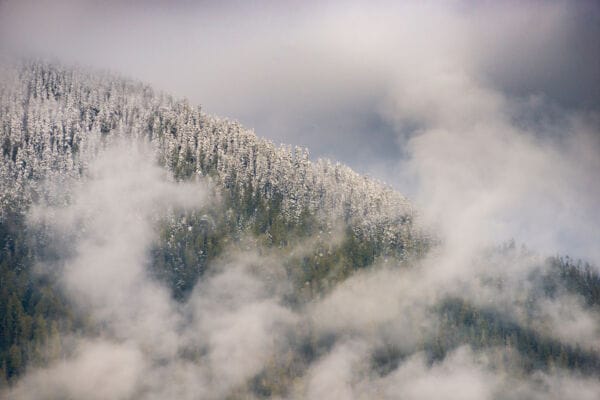
I was assigned a spacious, spare, comfortable apartment at the headquarters “campus.” I was given a master key to all the locked gates on all the roads in the Forest, and an official Forest Service radio – a heavy, black, brick-like thing – with which I could listen to the daily weather updates, the chatter of other Andrews scientists and managers, and call in for a rescue in case of emergency (if my car went into a ditch on a back road, if I slipped and broke my leg on a remote trail, or if I got lost wandering in an old-growth watershed). I felt like a kid, officially let loose: “Go out and play, and if you get in trouble, call the Frissell Ridge repeater on your radio!” So, I did go out and play in the amazing forest landscape of the Andrews – and never had to call for a rescue. October is when the transition from dry to wet typically happens in Oregon’s strongly seasonal climate; this year, the majority of my days were glorious. This was my idea of heaven.
At first called the Blue River Experimental Forest when established in 1948, it was renamed for Horace J. Andrews in 1953, after his untimely death in a car accident, because of his instrumental role in the selection of the site and establishment of the research there. Andrews and his colleagues were interested not only in the value of wood that could be harvested from Pacific Northwest forests, but also other forest-dependent values that were barely coming to be recognized, especially water in watersheds and habitat for fish. At that time, the relationships between forests, water, and what is now called “biodiversity” were not well known, and the burgeoning timber industry really didn’t want to know anything that might slow down their program to cut all of what they called “decadent” old-growth forests and replace them with “efficient” two-by-four-producing tree monocultures.
The site chosen for the experimental forest was the entire 16,000-acre watershed of Lookout Creek, whose water joins the Blue River, a tributary of the McKenzie River; the McKenzie flows westward from the Cascades into the Willamette River near Eugene, Oregon.
The common phrase “can’t see the forest for the trees” refers to a situation in which a holistic, “big picture” view (in time or space) is blocked because of giving too much attention and weight to details in the foreground. I also think of it as referring to reductionistic sciences, which atomize observations and silo knowledge – in contrast to holistic sciences, like ecology, that synthesize and integrate observations to seek the big picture, the “whole” that is more than the sum of the parts. Research at the Andrews Experimental Forest has been guided by an integrative, interdisciplinary vision from the beginning. Andrews managers and scientists were interested in understanding the full range of forest benefits and values, and recognized that would require understanding how forests function ecologically – “seeing the forest,” not just looking at the trees.
See Byers’ photos and read more from his “Explorations in Oregon’s Andrews Experimental Forest.”