The Deadfall on the 305 Road

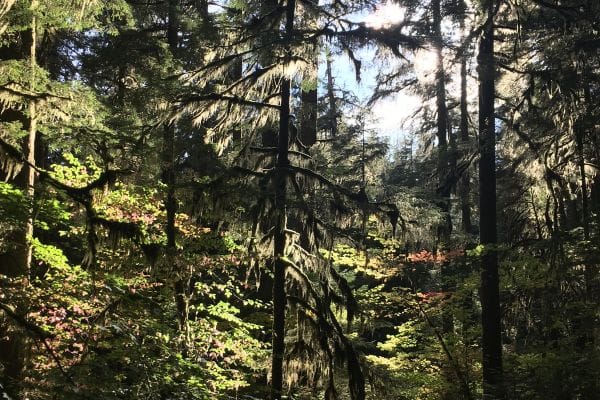
A stroll among the giant trees of the Pacific Northwest’s old-growth forest will put almost anyone in a reflective mood, and as I park my car by the gate that blocks Forest Service Road No. 305 in western Oregon’s H. J. Andrews Experimental Forest, I crane my neck to take in the magnificence surrounding me. Douglas-firs rise to dizzying heights on either side of the road, drawing the eye upward. I came here to inspect an old clearcut at the end of the road, but down here the big trees have been left standing, and as I start out walking the forest presents a vision of changeless eternity. Ten minutes later I round a corner and encounter an immense fallen tree blocking the road, a reminder that these woods, like us, are subject to the pull of age and gravity. This one fell directly down the centerline of the road, leading to the amused thought that nature, too, wanted to close this former logging spur.
I climb up on the tree and pace out its length, working around the upright branches. At a little more than 200 feet, it wasn’t the tallest tree in the woods, but it’s still breathtaking in its prone position. Rarely do we get a chance to examine a mature Douglas-fir, branches and all, from head to foot. Deep furrows run along its gradually tapering trunk. An evocative fragrance rises from the crushed fibers. All this tree lacks is the snaggle top and massive, shelf-like branches of the very old fir, which form an airy ecosystem complete with mosses, shelf fungi and nesting voles. Those attributes require another century or so to develop.
Still, I’m glad that no tree of this size lies on the main road between my car and my temporary home at the Andrews Forest headquarters, three miles away at the lower end of the Lookout Creek drainage. I’ve already had to squeeze my little Honda around several partially cleared deadfalls. I should be carrying a chainsaw, but I nstead I’ve been issued a two-way radio with which to call for help should I be stranded up here.
So much is vertical in this forest that it’s easy to overlook a fallen tree unless it blocks one’s path. The firs, hemlock, and cedars stretch out in multiple dimensions: toward the heavens, along the mossy forest floor, and (as is evident in this ancient forest) across great swaths of time. Many trees in the Andrews Forest approach 500 years in age; some Douglas-firs in favored locations in the Cascade Range exceed 800. It takes some mental stretching to perceive the long past out of which these giants grew. Growing up in Eugene, 40 miles down the McKenzie River from here, I marveled at trucks carrying a single log to a sawmill—a rare sight even then. Slices from such specimens would sometimes wind up in museums and visitor centers, marked with dates reaching back to the Magna Carta. We comprehend the age of such trees only in relation to written history, for our culture lacks an oral tradition extending more than a generation or two.
Continue reading Swanson’s essay in Terrain.org.