To Stand by a River and Go
“Though we travel the world over to find the beautiful,
we must carry it with us or we find it not.”
–Ralph Waldo Emerson
A gauzy drape of clouds hung over the mountains like an old, familiar question. What am I doing here? The clouds looked thin and light, yet still concealed the rocky, jagged beauty beyond. As I shifted to low gear, to climb the steep, winding two-lane road, the clouds slowly blew over, and the Western Cascades reappeared.
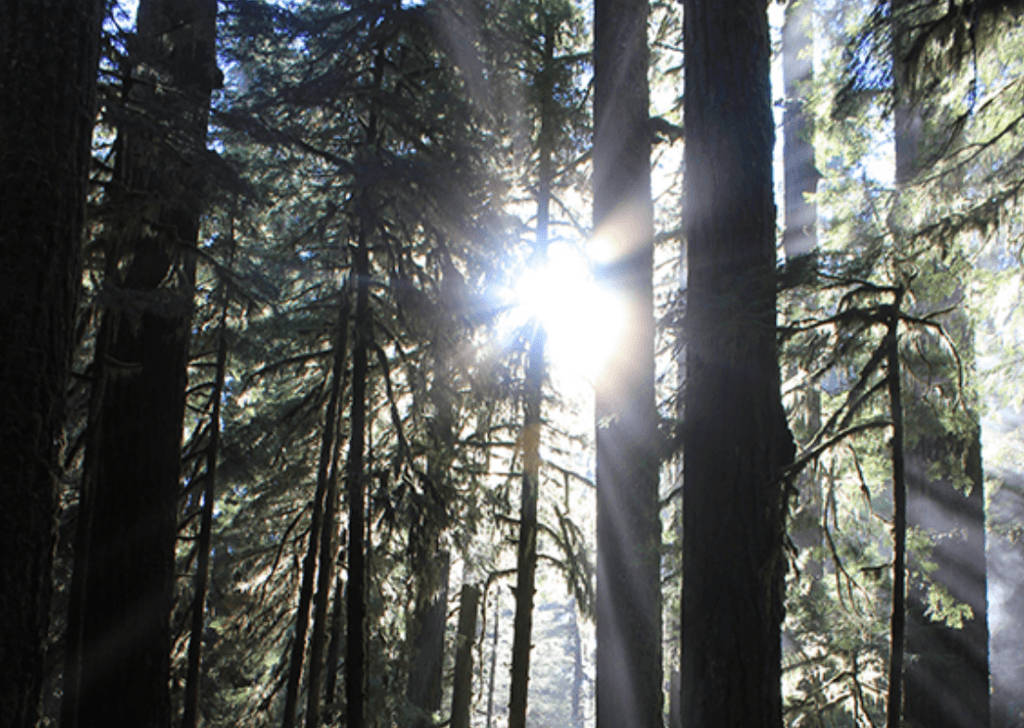
I was on my way to the Andrews Experimental Forest in central Oregon for a two week visit: to write and walk, and meet a few scientists—hydrologists, botanists, biologists. Artists and scientists have different kinds of response abilities, so the hope is that the writers’ searching for words in the woods will somehow converge with the scientists’ researching for data. The language of metaphor against the language of measurement. The scientist collects numeric info with her sensors—a decaying hemlock log’s carbon emission in kilograms per year. The artist captures the rotting log with his senses—the colors and smells that reveal how life and death are convergent. Both kinds of perception matter: numbers and words, math and myth. But what’s remarkable about this program—“The Long Term Ecological Reflection Project”—is how long-term it is: 200 years. From 2003 until 2203 hundreds of writers will visit “the Andrews” to enter an ongoing conversation with trees and trout and rocks—and scientists—about our evolving relationships in our shared home.
First, the Andrews Forest in numbers: 15,000 acres of wilderness, 53 species of mammals, 164 species of birds, 3100 invertebrate species, 20 species of reptiles and amphibians, 505 plant species, 7 feet of rainfall per year, a maximum elevation of 5340 feet, 40% of the forest is old growth, 25% was harvested for timber, the tallest tree is 299 feet high, the oldest about 700 years. Lookout Creek’s mean annual discharge: 121.83 cubic feet per second.
The Andrews, which was established in 1948, is remote but not untouched. Hundreds of red, black and white ribbons knotted around hemlock and fir and cedar branches mark various botanical studies. And dozens of thermometers and gauges and infrared cameras monitor everything from tree surface temperature to leaf breakdown in streams, to how soil nutrients impact carbon storage, root decomposition, and nitrogen fixation in trees and other plants.
But back to my original question: The emphasis is on “I.” What was I doing there? After ten hours of travel—4 in a plane and 6 in a car—and still a half hour away from the Andrews, I was beginning to have doubts. Oregon is a gorgeous drive-to state, but I know little of the culture or ecology of the region. I’m a life-long Midwesterner—from Iowa, a drive-through state, an economically productive but damaged, defeated sort of landscape.
I learned long ago what Iowa stands for: Idiot Out Walking Around. Who doesn’t love such comic humility? I do. There are no national parks or forests or sea coast in Iowa, or any professional sports teams. The highest “mountain” is Hawkeye Point, near Sibley, at 1670 feet. And there is one enormous green ocean that covers the state—13 million acres of rippling, waving corn. Yet the beauty in Iowa overwhelms me: the sweet, musty scent of freshly cut hay, a raccoon waddling out of waste-high weeds like a little furry tank, a slow string of cattle grazing along the fence line at dusk in the soft, golden light. I lived in that beauty for two decades, but didn’t know it then—that all those years fishing and hunting along the railroad tracks and walking beans and castrating pigs and trimming apple trees and picking sour cherries all led to the daily miracle of feeling at home there.
So how do we learn to see beauty in nature, wherever we are, and to belong to it? And can/should that be measured?
Continue reading Fate’s “To Stand by a River and Go” in About Place Journal.