Let Them Tell You
It was his first day on the job alone. When Brian had been with him—training him, as it were—he’d been focused on following Brian’s lead. They hiked to the designated tract, listened, called, listened again, made very sure of the identification. He was a good shot. Together they measured, sexed, noted conditions. They made a habit, after, of eating Snickers bars. They didn’t talk, not the kind of talk that meant anything.
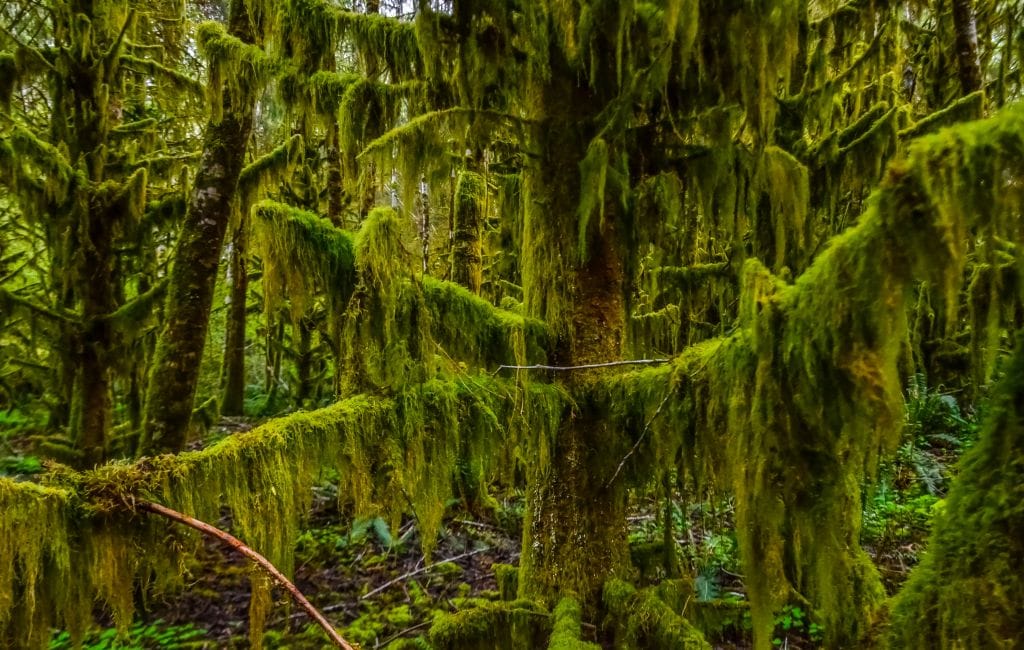
Today, though, by himself, Tad talked to himself. Or at least thought to himself. He thought how much he loved being in the woods, moving through the ancient Doug firs that were like a cathedral, stepping over fallen branches laced with Lobaria, listening to the deep quiet and the drumming, far off, of a pileated woodpecker. This was why he had become a biologist. He’d imagined spending his life in the woods, studying the behavior of the mountain beaver or the nesting habits of the American dipper. He loved all animals, more than people. He loved being with them and learning about them. He loved even the mosses and the centipedes, the tiny mushrooms and the molds.
He sat for a long time on a log at the site, listening to branches rub against one another in the breeze and admiring the yellowing of vine maple leaves. He said to himself, “Ask the beasts and let them teach you. And the birds of the heavens, and let them tell you.” It was something he remembered from childhood, from the Bible, before he gave that up. It had come back to him, from somewhere deep inside. He wanted to ask the beasts and the birds, why do humans keep messing things up? Why can’t we let you live in peace?
He had a job to do, though, and so, after a while, he got out the digital recorder and turned it on. The eight notes rang out: hoot-hoot-wahoo, hoot-hoot wahoo. Right away, he got his answers, the same pattern, twice. The pair of owls hooted their alarm at the intruder, hoping, Tad knew, to drive him off.
In less than a minute, one of the two coasted in and landed on a branch not twenty feet away. It was the female, he could tell by her size. Her huge dark eyes, like holes into the universe, stared out at him.
He shot her.
After he collected her, he sat for several moments with her, stroking the beautiful soft feathers covering her breast, feeling the life go out of her.
He called in her mate, and shot him, and carried the two of them away. He bagged and labeled them and deposited them in the wildlife department’s freezer, and then he drove home as the sun was sinking over the mountains, a cup of coffee between his thighs warming him.
Tad lived with his parents, because it was easier that way, until he repaid some of his student loans or got a job somewhere farther away. It was easier, except when it was hard, which it sometimes was, with his father. His father had lost his job as a logger during the timber wars, before Tad was even born, and Tad had never known him to be other than bitter about that and about government interference in general.
Tad was well aware of the ironies involved. First, he knew that his father loved the woods as much as he did. The woods had been—still were—his father’s spiritual home, the big space where he felt most alive. At the same time, his father had never really seen a conflict between loving woods and cutting them down. He was among the last to believe there would always be more—over the next hill, around the next bend, after the next grow. He also was firm in his belief that God’s gifts were meant to be used by Man.
As for the despised government—yes, the use of the Endangered Species Act to protect the spotted owl had upset the loggers, but government programs had kept their families afloat for many years.
His father had been stubborn enough to think that the jobs would come back. While he waited, he’d taken up small engine repair and chainsaw carving, and he had made a minor-key life from that, helped along by the home care Tad’s mother did for older people. And government assistance. They got by.
Tad had learned, long ago, not to argue with his father. They could both love the outdoors and yet feel very different about a forest’s purpose.
Since the time he was old enough to ride along in the front of the pick-up, Tad had helped his father scavenge logs for carving. He woke mornings to the sound of a chainsaw and as often went to sleep by the same roar. He’d helped, again, load finished carvings into the pick-up and deliver them to the general store/café/laundromat that sold them. The carvings were mostly of bears, standing upright, roughly made but popular with tourists—cheap enough for an impulsive buy, small enough to fit into a car’s trunk, friendly enough to sit on someone’s porch.
In college, Tad had learned that what his father made were referred to as “value-added forestry products.” His father called them “tourist trinkets.”
When Tad entered the house, his mother was frying up sausages and his father was sitting at the kitchen table, watching a news program on the rabbit-ears TV they kept in the corner.
“How was your day?” His cheerful, red-cheeked, busy-with-a-spoon mother expected every day to yield some new great wonder or achievement.
“OK.”
He went into the bathroom to wash up. He patted his hair down and picked a piece of lichen from his beard.
They ate quietly, the TV turned to a murmur about the usual outrages conducting by the usual clowns in Washington. After a while his mother turned it off. “So,” she said, “how was it?”
“It’s a job,” Tad said, looking at what was left of his green beans.
“Oh, c’mon now. We’re interested in your work.”
“Yeah,” his father added. “What’s today’s body count?”
His father, Tad knew, did not embrace the distinction between the spotted owls that he believed had cost him his job (along with ruining the entire economy of the Northwest, as he saw it) and the invasive barred owls. Owls were owls, as far as he was concerned. One had a spotted breast and the other had a barred breast. Big deal! What difference did that make?
“Two,” Tad said. “We’ll see if spotted owls move back into the territory. That’ll be the more fun part—monitoring to see what happens once the barred owls have been removed.”
His father laughed. “Removed. Like you just trucked them over to the next county. The big county in the sky, I guess.”
In truth, Tad was not thrilled with the language of the program. Removal. Lethal removal. Barred owl management. Bureaucratic language for sure, not unlike—he thought—the word pacification for what was done during the Vietnam War. When it came to killing, no one wanted to be so blunt.
His mother wore a tight smile. “Didn’t you tell me that the barred owls actually body-slam the smaller owls? They attack and kill them?”
Tad nodded. “There’s some of that. I think that mostly they just drive them away. And then they don’t breed successfully.”
Tad knew that his parents knew the basics of what was happening between the two species. You couldn’t live in the Northwest and not be aware that barred owls had moved in from the east and were usurping the habitat of the endangered spotted owls. The barreds were not only larger; they were more aggressive and more adaptable. They could out-compete their smaller cousins for food, nesting spots, and territory generally. They were increasing in numbers all through the forests, and the spotted owls were in sharp decline.
Of course it was maddening to everyone who’d lost jobs when logging was shut down. He understood that perfectly well. He’d heard the guys who sat around the table down at the café, where owls had been a staple of conversation for longer than he could remember. The men were newly angered now, reliving the shut-down, complaining that they’d been unfairly blamed for whatever went wrong for spotted owls; those damned other owls had been the culprits all along.
If Tad knew otherwise—that the loss of old-growth forest the specialized spotted owls relied on had been a serious problem and that the invasion of barred owls competing in what habitat remained was only a new and compounding threat—he wasn’t about to try to convince anyone who believed otherwise. He was not going to tell anyone who didn’t want to hear it that old-growth forests had ecosystem values far beyond that of housing spotted owls, that the owls were just an indicator species for so much more.
His father rattled his fork on his plate. “That’s Nature. Survival of the fittest. I still don’t get why you-all are interfering. Let Nature take its course.”
“That would be an option,” Tad said, and got up from the table. “That could definitely be an option.”
Out in the shop, among his father’s tools and half-carved chunks of wood, Tad sat on a stool and cleaned his government-issued shotgun. His eyes drifted to the old bumper stickers stuck over the work bench: Save a logger, eat an owl. Spotted owl, finger licken good. There’d been a sign down at the café, too, for years. It might still be there, and he just didn’t notice it anymore. It could have become part of the landscape. Spotted owl soup.
That was the environment in which he’d grown up. He wasn’t sure how he’d escaped it, that bitterness. While no one was actually eating owls, the stickers and signs weren’t ha-ha jokes. No one had been laughing. These were people who couldn’t spell lickin’. What kind of new jobs were they supposed to get?
His father came into the shop, picked up a rasp, and started tidying up a roughed-out bear.
Exhibit one, Tad thought, and wished he could unthink it. His father had done the best he could, providing for the family. He’d encouraged Tad and his two sisters to take their educations seriously, and he’d been seriously disappointed when the girls got married too soon—to local boys who were not the brightest bulbs. Tad knew that both his parents were proud of him for finishing college and maybe now even going on to grad school. He was thinking about it. He wanted to be more than a wildlife tech, but he didn’t want to be the kind of biologist who sat in an office writing reports.
The two of them went about their work quietly. They had always found the shop a refuge from the female chatter of the house. Tad had sometimes done homework there, and built boxes for displaying his collections of rocks and beetles. His father had taught him to use hand tools and, of course, chainsaws—for cutting firewood. The old man had always reserved the carvings for himself. And, Tad would freely admit, he hadn’t had that much interest, either in wood carving or in fixing other people’s abused chainsaws and lawnmowers.
Whenever Tad had lingered around the carvings and the saws and the disassembled motors and parts, his Dad had said something like, “Don’t you have homework to do?” What Tad had heard was, Don’t mess with my stuff. What he’d come late to understand was a different message: Don’t you have something more important to do? Won’t you be better than this? This is not your future.
Now, Tad noticed that his father moved around more stiffly than he used to; he was a little stooped, and at one point, standing after squatting, he grunted with the effort. He was not old, just older, graying around his ears. He was still impressively strong, capable of hoisting huge logs end-over-end to walk them out of the woods. His hands were large and callused and steady.
Tad was still hearing—running though his head—his father’s words about letting Nature take its course. It was a perfectly reasonable argument. In Nature, change is the only constant; that had been drilled into him in school. If evolution was running towards simpler ecosystems with less diversity, was that not just the way it was? In an age of extinction, what was one more species lost? There would still be owls in the woods.
All this had all been discussed in the environmental assessment and in various published papers involving management strategies and ethics. But the complicating factor was the human one, the role people played in turning the Great Plains from a grassy barrier to a pattern of agriculture and trees that allowed the eastern owls to hopscotch their way across the continent.
One interference necessitated another interference. Tad accepted this, if not gladly.
He could hear his father saying, because he’d said it often enough in the past, “People are part of Nature, too.” Yes, Dad, people are part of Nature, too, except that no other creature is capable of doing so much damage to other creatures, of so violently altering the conditions of life on Earth.
This was the argument he didn’t want to have with his father.
Tad had slid open the door to leave when the owl called from the darkness.
Hoo-ha-hOO, hoo-hoo. Hoo-ha-hOO, hoo-hoo.
He stopped in the doorway.
“The great horned speaks,” his father said from the workbench, where he was prying open a can of varnish. The smell seeped into the room, pungent as pitch.
From afar, another owl answered. Ha-hOO, hOO, hOO.
Tad had eventually learned the calls of all the local owl species, but the great horned was his first—and his first, like the first of anything, was foundational, bedrock to his known world. Among his earliest memories was being held in his father’s arms on the back porch, peering into black space, stars up above, silence all around except for the call, hoo-hooing and then sometimes hoo-AH. That had been, perhaps, the beginning of mystery for him. What was out there? What were the lives of forest creatures like? What were they saying to one another? Later, his father had shown him the imprint of owl wings on snow, where the tracks of a field mouse had come to an end, and they’d collected owl pellets and pulled them apart to look at the tiny bones inside them. His father had been a keen observer of everything in the woods and fields; he’d never have claimed to be a naturalist, but he’d been a good one.
There’d been no conflict, then, for his father to enjoy the one kind of owl, or owls generally, while despising the spotted owls. It wasn’t the owls themselves he had ever hated—just the trouble they caused.
The nearer owl called again. “You taught me that call,” Tad said. “You taught me the name great horned owl and that call. You stood on the porch and called one in, until it landed in a tree where we could see it in the moonlight. You showed me in a book the picture of it, with those amazing ears and yellow-moon eyes.”
His father laughed. “And look what that got me.”
“What?”
“A biologist.”
They were quiet then, waiting for the owl to call again. Tad had the sense that
his father had started to say more but had cut himself off, for once maybe editing himself.
Tad said it instead. “A biologist who shoots owls.”
His father bent over his work, filing, blowing away dust. He didn’t confirm the thought; he didn’t deny it. He looked up. “You know, I never even heard a spotted owl, not that I know of. I never saw one.”
“I never saw one, either,” Tad said. “Not until I worked on the study.” Then, the birds had followed the researchers around, because they fed them white mice. They didn’t seem nervous around people. The theory was that, because they lived in such dense forests, up in the canopies, they didn’t associate with people and never learned to fear them.
“I’m sure they’re a beautiful bird. All owls are.”
“Yes.” Tad thought of the spotted owls floating down, soundless, legs outstretched, talons open, towards the terrified and twitching white mice. Their faces so intent, framed with dark crescents, the lighter x-marks between the eyes. And he thought of the barred owls, those similar open faces and blackest eyes, watching him. Their beautiful, beautiful feathers.
“So,” his father said. “After they come back, what keeps barred owls from also coming back and chasing them out of the territory again, or killing them?”
“Nothing. In the longer term, nothing.”
His father straightened, scratched at an eyebrow. The fluorescent light , overhead, created shadows under his eyes and cheekbones. “So you can never stop. You have to keep shooting them, forever.” He shook his head, and a smile crept onto his face. “I guess that’s what’s called job security.”
Tad saw himself, grizzled like his father, humping through their beloved woods to an owl tract, the same tract, and the same tract again. Like that old movie, Groundhog Day, the same thing again and again, year after year.
The owls had quieted, found one another, were absorbed into the night.
So many mysteries, out there in the woods. In the dark everywhere.
The shotgun hung heavy from Tad’s shoulder. Tomorrow, another hike through woods, more words with himself, questions he could answer and some he could not. He stepped out and closed the door behind him.
“Let Them Tell You” was published in Saltfront, Issue 8, Fall 2019. Reprinted in Dark Mountain, Issue 21, 2022. Republished in Let Them Tell You: New and Selected Short Stories, University of Alaska Press, 2026.