The Owl, Spotted

Steve Ackers and I clamber over vine maple and Oregon grape, a tangled mess of scrub that covers Hardy Ridge high over Cougar Reservoir in Oregon’s western Cascades. This terrain is better suited to flying squirrels and red-backed voles than to a mildly arthritic, bipedal primate. But here I am on a sun-drenched morning in mid-May, hiking with the head of the northern spotted owl research team from the H.J. Andrews Experimental Forest and filled with unaccountable joy. Last night Steve was orienteering toward an owl that was calling from a mile away. He set a compass point and hiked into the dark forest toward the call, but never found the bird. He’s been working on the owl study for seven years, on wildlife fieldwork for 21. Today we’re looking for a spotted owl that has been in the study for 12 years, one habituated to the visits of field scientists.
Extensive study of this species had been conducted for at least a decade prior to its 1990 designation as threatened under the Endangered Species Act. The northern spotted owl is perhaps the most studied bird in the world, inspiring unprecedented collaboration among scientists, federal and state agencies, universities, and landowners.
We break into an opening shaded by a small stand of Douglas fir—trees not super-old, as we’ve seen along the McKenzie River Trail, where there are giants 600 years old, but stately elders nonetheless. The ground is dappled with light, the air cool and damp. The hillside slopes steeply below. Ahead of me Steve hoots the four-note location call: hooh-hoohoo-hooooh. The last syllable descends with a slight warble. No response. Then he turns and a quiet smile opens on his face. He has the bright and easy look of a man who knows how lucky he is to love his work.
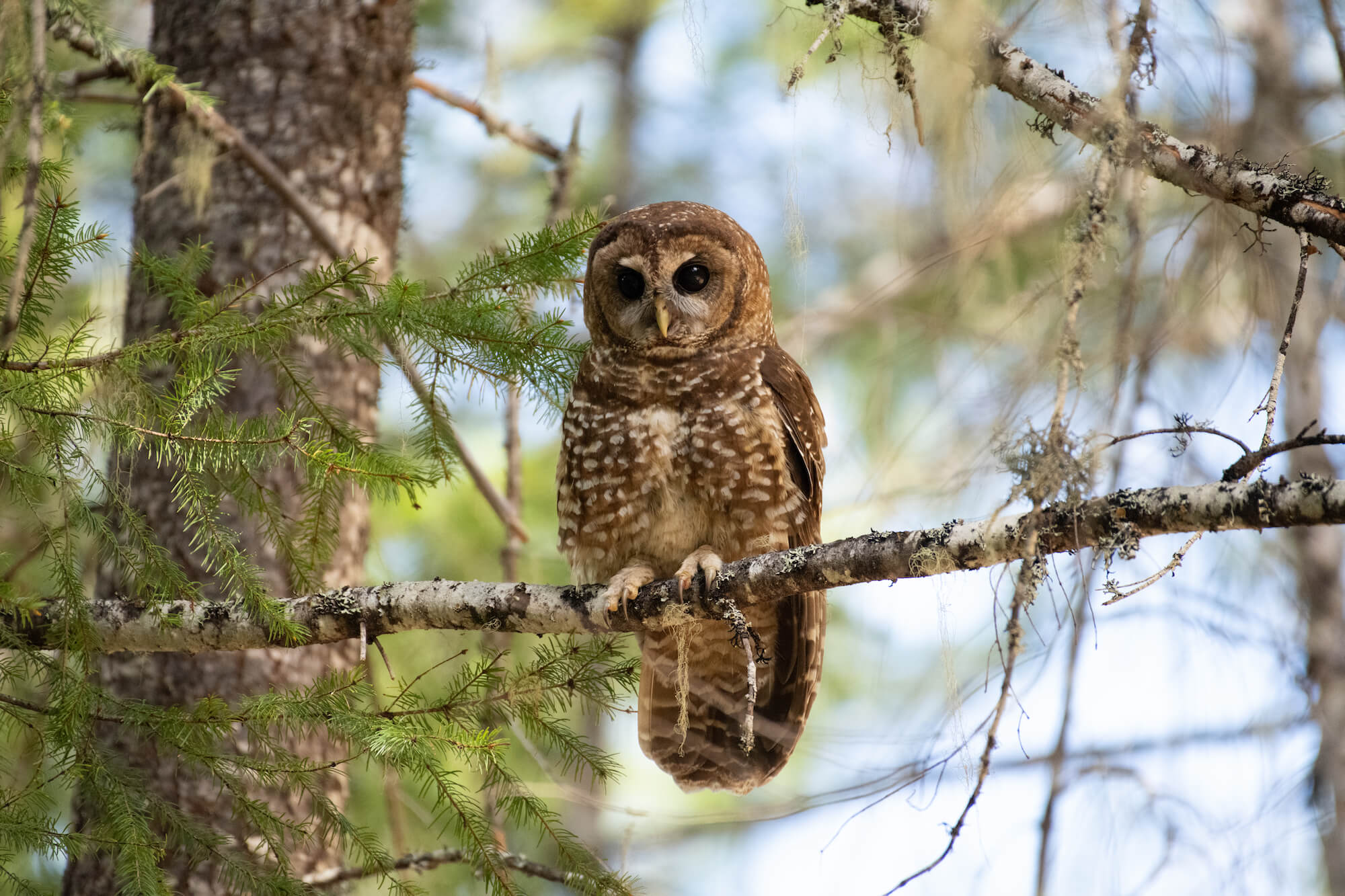
Silent, she’s perched on a small understory branch 20 feet up. She’s watching us, waiting for us to notice her. She knows the contract. She will give us data, we will give her mice. After three decades of research on the northern spotted owl, scientists have gained a wealth of understanding about this creature’s life history. Each spring the field crew checks nesting pairs for their reproductive status and bands all fledglings to include them in future surveys. The data gathered led in 1994 to the comprehensive Northwest Forest Plan, which decreased the rate of logging and altered how it is done, giving the owls and their entire ecosystem a better chance at survival. But data cannot compare to the experience of that deep well of attention, quiet, and presence that is the owl. She has a spotted breast, a long, barred tail; and tawny facial disks with brown semicircles fringing her face and back-to-back white parentheses framing her eyes. These markings give the impression that her eyes are the size of her head. The blackness of her pupils is so pure they look like portals to the universe.
When Steve takes the first mouse out of his aerated Tupperware container, lifting it by its tail and placing it on a log, the owl drops, silent as air, down through the branches and closes her talons. She lofts back up to the branch and scans around. She may be looking to see if a goshawk is near. Whatever constitutes a threat to her does not include us. How rare is it to have more than a fleeting glimpse of a creature in the wild. Still clutching the mouse, she burps up a pellet that plops to the ground, gives us a nonchalant look, then gulps down her meal.
“You want to see the parachute drop?” Steve asks with a grin. He places a second mouse on the log, and she billows her wings, buoying herself down to us. It takes a moment to understand why her flight catches me each time by surprise. No riffle, no flutter of resistance through the feathers. The spotted owl is a sit-and-wait hunter, unlike the goshawk, which will tear through the woods in pursuit. The fringed edge to her wing reduces noise and increases drag, making this strategy a good match of form with function.
Steve collects the pellet and we poke apart the slimy gray glob of indigestible fur and bones from the past day. The bones are very delicate, still shiny with the life that left them, some nearly two inches long.
“Maybe a woodrat,” Steve says. Through binoculars he can see the owl’s identification band. Last year a male was keeping this female company, a two-year-old from King Creek. This year, so far, she appears to be alone. The owl team’s last visit to this site was one month ago.
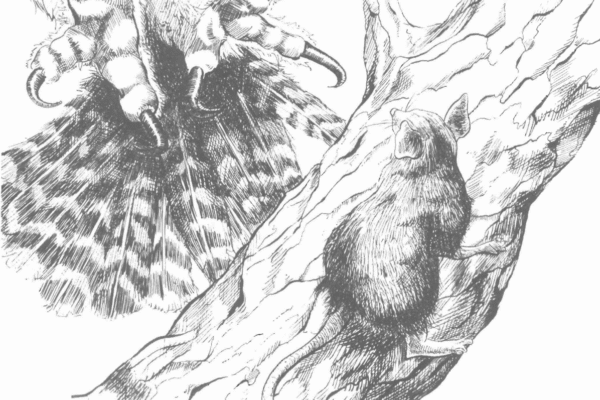
“How about the side grab?” Steve asks. He might be a dad boasting about the agility of his soccer-playing daughter. He isn’t making the owl perform for our enjoyment. These flight skills are as natural to her as stepping over a crack in the sidewalk is for us. The mouse is barely out of his hand, scurrying in confusion on the tree trunk that rises beside me, when the owl swoops onto it, talons leading, and picks it off. It happens to fast that she’s flying away by the time I realize she’s grabbed the prey, killing it instantly in her grip. She flies up to a snag broken off 40 feet above the ground and tucks the mouse carefully into the jagged wood. This is a cache, not a nest. If she’d been delivering food to her young, the nest would be a natural platform high in a tree. She checks to be sure the mouse is well hidden. If she does have nestlings, she’ll come back later for takeout.
The spotted owl research protocol demands that we spend an hour with the bird. She’s had her limit of commercially raised albino mice, so now we sit to see what she does and if what she does will tell us whether she has a mate or nestlings. This suits my research protocol just fine. I”m here as part of the Long-Term Ecological Reflections project initiated by the writer and philosopher Kathleen Dean Moore, who works out of Oregon State University. Like many of the scientific experiments conducted in and around the Andrews forest, my humanistic assignment is part of a project intended to last 200 years. This timeframe was inspired by a hallmark study being conducted in the Andrews, the log decomposition study. Two hundred years is roughly the lifetime of the giant logs left to rot on the forest floor, and during that time successive teams of scientists will observe and measure the dead wood’s contributions to forest regeneration. Writers are invited to visit several sites in the forest and to leave an account of their experience. The hope of this project is that by careful and sustained observation, a testimony on behalf of the forest will have kept it alive.
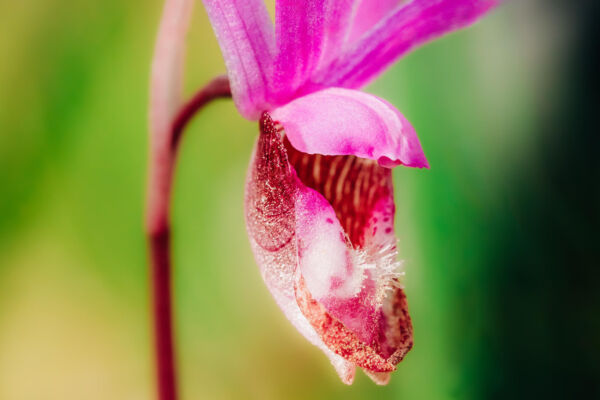
The owl doesn’t make a sound. She perches on a branch high above us. She is still. She watches us. She reaches her head forward—”the pre-pounce lean,” Steve calls it—as if she has seen some prey on the ground. The song of a thrush flutters through the quiet, the auditory equivalent of seeing an orchid in the forest. Beauty is what I came here for, a beauty enhanced, not diminished, by science. If I had only my senses to work with, how much thinner would be the experience. What a record we might have of the world’s hidden beauty if field scientists and poets routinely spent time in one another’s company.
A young tree, broken and caught between two others, creaks to the rhythm of the wind. How well the owl must know this sound. Does she anticipate the crash of its falling? What is the consciousness of a spotted owl? There she perches perceiving us, and here we sit perceiving her. We exchange the long, slow, interspecies stare—no fear, no threat, only the confusing mystery of the other. Steve knows her language well enough to speak a few words: the location call, a bark of aggression. Perhaps that means she things we are owls, catching and offering prey, being still, and turning our eyes to the forest.
“What are you?”
“What are you?”
That’s the conversation we have with our eyes.
“What will you do next?”
“What will you do next?”
I keep following the owl’s eyes. Then we stand up and hike down from that high place.
“The Owl, Spotted” originally appeared in On Earth.