Debris
I. The Forest
Seed spore egg,
a curl of lichen or moss,
a feather, a fallen twig,
a pebble. Summer drought.
Water drips from a decaying log
laden with nitrogen.
Winter floods: boulders
crash down Lookout Creek.
A four hundred year fir falls,
blocks the channel. Gravel bars
shift stone by stone.
A single alder leaf turns in an eddy.
Roads wind up Lookout Mountain.
Locked gates, flags, tags,
and stakes mark research plots,
the gathering of information:
carbon dynamics
disturbance patterns
habitat structure
nutrient cycling
log decomposition
debris flow.
Only in the mind can there be
one red-backed vole, one owl, one Douglas fir.
Only in the mind can there be
fir without fungus, owl without fir,
fungus without vole.
Study the wind, listen to what it says
about the shape of the land,
the shape of a stone,
the shape of the needles that sieve it,
the open place in the canopy
where a tree fell in the last storm.
Study the taste of creek water in September
before the first winter rain,
the taste in May when the snow melts.
Study smell, study texture,
take the petals of a violet,
the leaves of miner’s lettuce between the teeth.
Let the tongue explore,
the body learn the forest inside itself.
Study love and the way love tangles
with fear. Study desire and the light
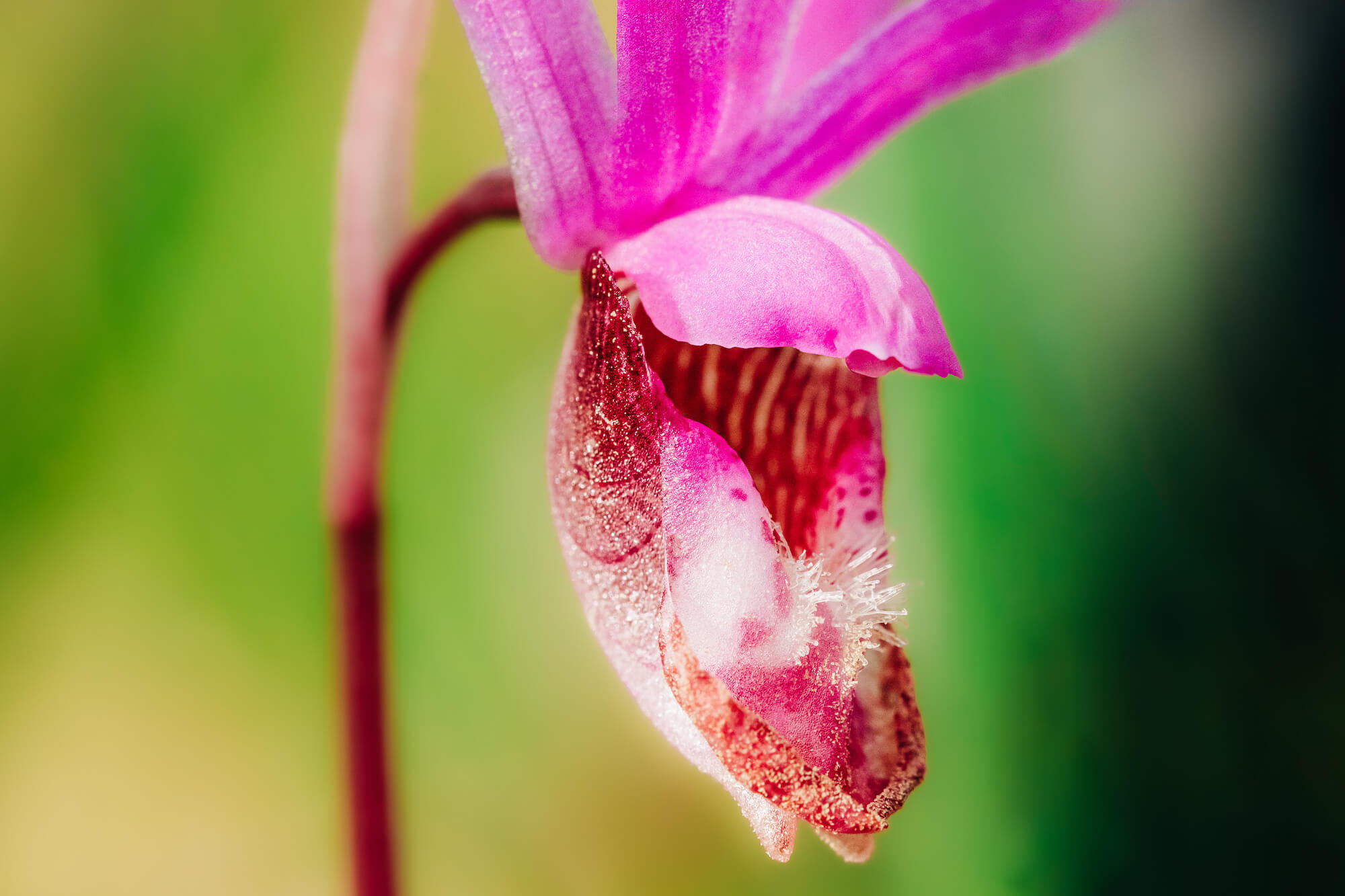
that makes the coralroot glow.
Study the wind. Listen
to what it says about you.
Learn about time
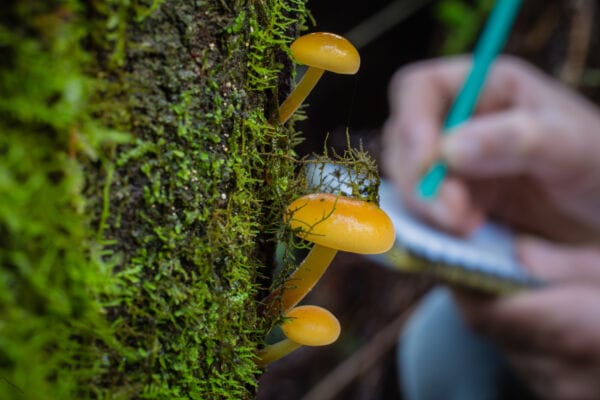
from lichen and moss,
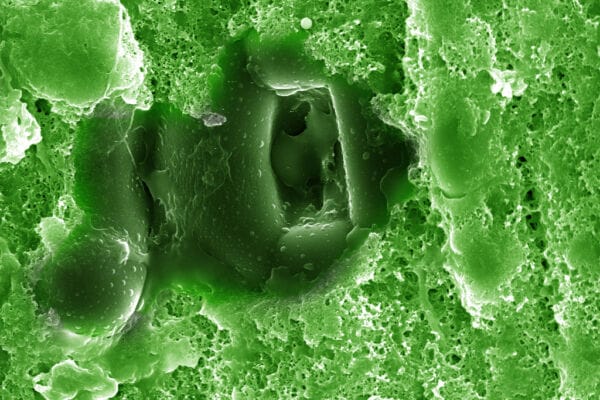
from the thick mats of mycorrhizal fungi
spreading underground,
from the Western red cedar,
roots gripping the shifting hillside
as the wedge of light
widens, travels up the trunk–
learn from a cedar splitting its own heart
with its own strength.
Heavy with age, forest silence
shimmers, might be measured
as particle instead of wave.
Here, moss and bark, fern and rotting wood
hold centuries of bird calls,
animals cries, human voices,
weaving them into the shhhh of wind,
the blursh blursh blursh of the creek,
the crash of a tree falling, a branch
snapping, a cone sprinkling seeds
on the forest floor.
Here, silence has weight and texture,
can be tasted and touched,
taken into the body like the gold drops
of sap dripping from a branch,
like the sweet of violet leaves.
Here, silence lets the heart question:
How does moss, dry
for a season, revive in rainwater?
An orchid sprout from a seed,
blossom without leaves or roots?
How does a wren shape its nest,
a kinglet know when to migrate,
a bear when to sleep?
How does a body learn to want
change–the slow evolution
of new life forms–and then accept
its own dying, say yes
to the single cell that mutates,
multiplies, metastasizes?
Continue reading Graham’s “Debris.”