Legacies of Decay
My father fell and broke his hip when he was reaching up to change a clock in his kitchen. Three weeks later, we gathered around to watch his body lower into the earth. A small hinge breaks, and the world unravels. He caught pneumonia in the rehabilitation facility two days after his surgery, and he was intubated for his failing lungs. After that, he never regained consciousness. My family took turns orbiting him on his last days. We held his swollen hands, combed his handsome silver hair off of his forehead, and whispered our own private words of love and forgiveness.
We sang Amazing Grace as his body was lowered, and the sweep of the foothills of the Rocky Mountains rose just west of the cemetery. I looked down into the hole where the coffin was being lowered and expected to find comfort there, to inhale the dark, rich smell of soil and roots and earth. Instead, his coffin rested in a grey concrete vault. It seemed lonely, his body slowly decomposing inside a coffin sealed off from the earth.
Up until this point, I hadn’t given a lot of thought to burial. Other loved ones had chosen cremation. When my mother’s best friend died, we skied to her favorite tree, an ancient gnarled limber pine near a high alpine meadow. We took off our packs, took out a thermos of ginger tea, some smoked salmon and cheese, and a ziploc bag filled with our friend’s ashes. My mother spoke to her friend, Joyce, directly, her name simmering with the heat of loss. She told her how much she missed her, how she was a little pissed at being left, and then we took turns taking fistfuls of ash and tiny bone fragments, throwing them into the woods where they scattered and left a thin grey layer on the white snow. Tiny shards of bone disappeared into the snow. They reminded me of fragments of bird or mouse bones found in owl pellets or coyote scat. It was a ceremony Joyce would have loved, and my grief pooled and quieted as I imagine these bits of Joyce’s body feeding the earth below this gnarled old tree.
The grief of my father’s death washes through me in waves. But the image of his body in a concrete vault has become a haunting symbol for me of our culture’s aversion to death and decomposition and the ways we are determined to keep ourselves separate and different from the rest of nature, even in death.
My stepmom said my dad never talked about what he wanted to have happen to his body when he died. What struck me is that “conventional” burial in the U.S. has evolved to mean a body is encased in one to two tons of concrete and often embalmed, which means the body’s blood and fluids are drained and then the body is filled with formaldehyde. If a body is cremated, it cooks for a few hours in a 1,800 degree oven, releasing soot, carbon monoxide, trace metals like mercury, and about 540 pounds of CO2. If our bodies are biological legacies, this legacy is one of toxic waste.
How did we get to a place where conventional burials go to such length to keep a human body from decomposing and returning to the earth? We are understandably attached to the bodies of the people we love. Cultures throughout history have embalmed their dead for different reasons, often to preserve the body for the spirit’s return. The Egyptians packed a dead body with resin before drying it in the sun, softening it with sacred oils, and wrapping it in linen. The ancient Babylonians, Persians, and Syrians immersed dead bodies in honey and wax to prevent decomposition. But embalmment wasn’t part of the American burial process until the civil war, when soldiers’ bodies were embalmed for the long train ride home. After his assassination, Abraham Lincoln was embalmed, and his body was displayed in an open casket in cities all along the route back to Springfield, Illinois. It’s estimated that a million Americans viewed Lincoln’s embalmed body, perhaps helping to shift public opinion towards embracing the practice. By the turn of the century, death and burial had moved from the intimacy of homes into the hands of strangers in hospitals and funeral homes.
We have outsourced the most sacred and intimate acts of caring for and burying our loved ones when they die. Imagine a body full of rot-resisting chemicals lying in a hardwood and steel casket surrounded by a concrete vault. It’s hard to imagine an image that would reflect a fear of death, fear of decomposition, and fear of return to the earth more poignantly.
***
Almost a year after my father’s death, I am on a writing residency in the Andrews Forest, a Long-Term Ecological Research site, founded in 1948, of twenty-five square miles of temperate rain forest in the Lookout Creek drainage on the western slope of the Oregon Cascades. In early March, the rain is steady and cold. Almost every surface here – rock, concrete, tree trunk, even the stop sign at the entrance to the headquarters – is furred or fringed in bright green moss.
The invitation of this residency is to contribute to a 200-year log of reflections by a succession of visiting writers responding to this place and some of the forest research happening here. The length of this invitation surprises and excites me. When I ask one of the leaders of this project when my contributions are due, he says that they like to have copies as soon as possible and then mumbles, “things happen, people die.” It hits me how rare it is to be asked to contribute to a project with a time scale that will far outlive me.
The research site that has captured my attention most is one that inspired the 200-year reflections time scale. Mark Harmon, the “head rotter” scientist in the Andrews, calls this research the “morticulture” study site. Here scientists measure decomposition of fallen trees and the ways these dead trees support the health of the whole forest ecosystem. Two hundred years is approximately seven generations, the time that many Indigenous cultures agree should guide any important decision making, and roughly the time that scientists estimate it will take for the tiny arthropods, fungi, and bacteria to do their work of transforming a giant fallen tree back to a dark, rich, nutrient-dense soil on the forest floor. Two hundred years is a long time for scientific studies that are usually geared around short publication and funding cycles, and in this time of climate unraveling, a 200-year study feels like audacious, fierce hope.
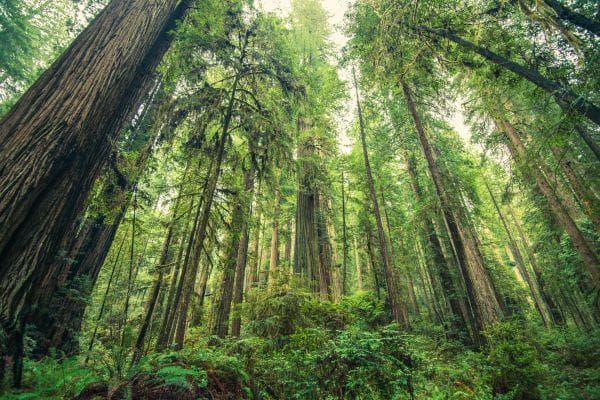
On my first walk in the old growth forest from my home in the high desert of New Mexico, my body swoons with the sweet, wet smells of this forest breathing and spilling life into death into life. The cycling of death and life in this forest is so immediate and abundant that the boundaries blur and then dissolve – a huge fallen Douglas-fir becomes a nurse log as moss, mushrooms, sword ferns, sprigs of salal, and little hemlock saplings begin the next forest on this fallen giant. I lean my forehead against the thick, loose bark of an ancient Douglas fir tree. At this angle, looking up, I see a forest in miniature – tiny delicate mushrooms spout along a crack filled with moss and powdered with bright green lichen. Forests inside forests inside forests.
I look in awe up a two hundred-foot mossy trail up an old growth Douglas-fir trunk, and something falls with a splat on my cheek. The forest constantly rains down pieces of life and death – feathers, cedar needles, squirrel dander, mushroom spores, dead beetles, lichen, linking the life in the trees and canopy to the ecosystems of decay in the forest floor. The soil is teeming with arthropods which start the decomposition process by chewing and excreting bits of plant material. And just below the ground, at the edge of the tips of tiny roots, is a zone so biologically rich with life, scientists call it the “rhizosphere.” In a single thimbleful of soil in this zone, there are more than a 100 million bacteria and several miles of fungal cells. Forests under forests under forests.
***
Fred Swanson is a geologist with a poetic heart who has researched in the Andrews for decades. I meet Fred in the parking lot surrounded by a group of Japanese college forestry students. They all wait with their pens perched over little notebooks, wearing running shoes and bright new rain jackets, then scribble down notes while their bus driver translates in Japanese. Fred explains how the “timber era” transitioned to an era of ecological forestry here, when a frog nearby croaks, drowning out the translations. Fred then reveals his poetic leanings. “Scientists here are focused on data,” he cups his hands outside his eyes to show a narrowed view. “We have our instruments, and we collect our data, and we communicate in this narrow way. But what we need are stories of how humans relate to this forest.” He pauses and looks my way, and I feel the Japanese students take me in for the first time. They must wonder why I’m here. “And for this, we bring the poets,” Fred extends his open palm my way. I smile and nod, suddenly nervous about my ability to create something that lives up to the honor of this expectation.
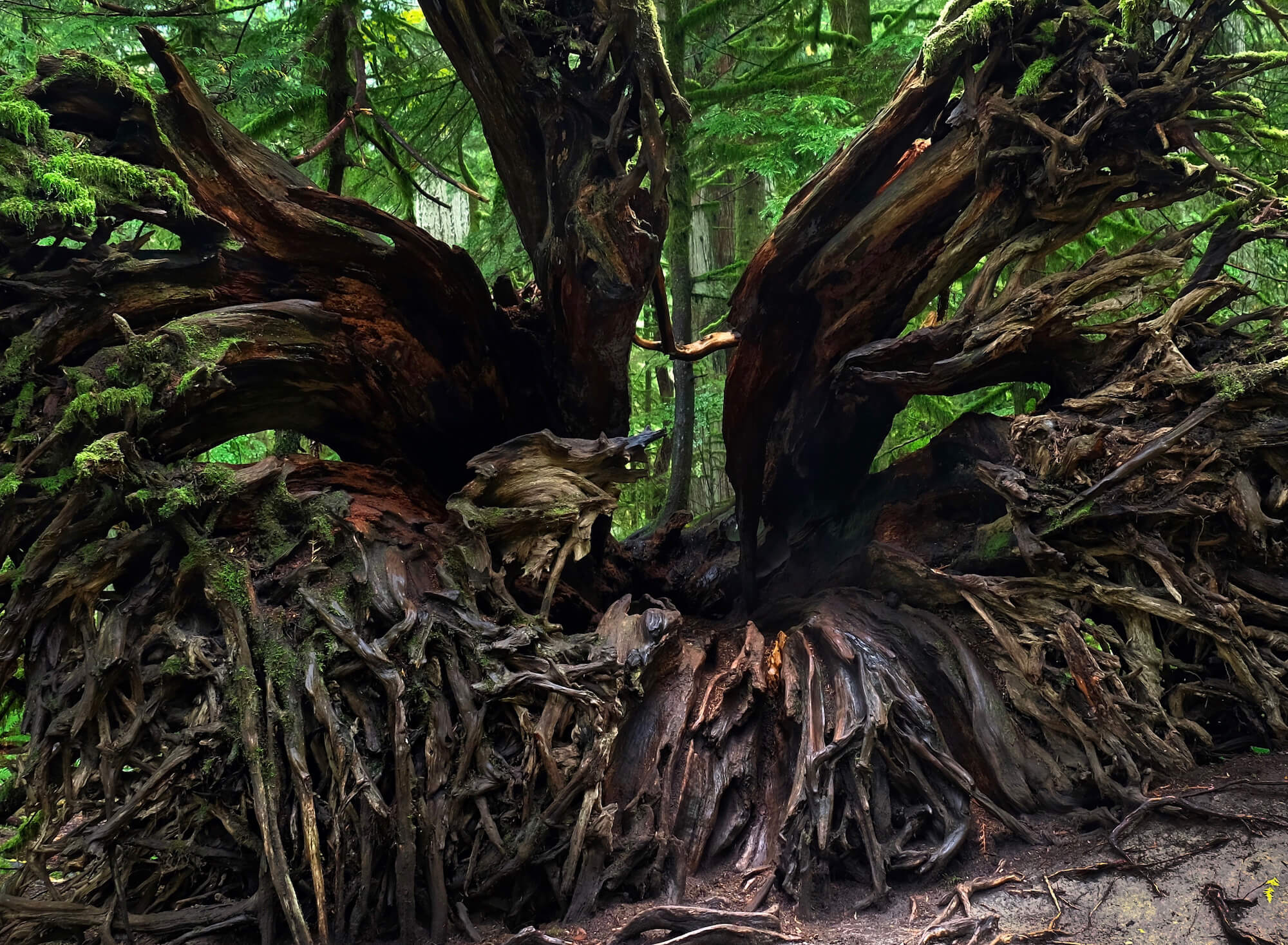
That afternoon, Fred leads me and the students down a narrow duff trail towards the decomposition site. Steady rain thwacks onto the leathery leaves of salal, rhododendron, and Oregon grape, and patters into the thick pelt of moss covering everything on the forest floor. “That’s a new fall!” Fred says, excitedly. “Look at the way that tore off – it’s sculptural.” A huge Douglas-fir splintered at the base, twisted, crashed into moss and salal, taking off nearby branches, and leaving fresh deep orange shards of wood scattered across the forest floor. Old Doug-firs sometimes develop “brown rot,” a fungus that eats the cellulose and can cause the tree to fracture at the base. Another fallen fir blocking the trail has been sawed through to make a passageway. There are fallen trees everywhere in this forest. Scientists estimate that one fourth of the old growth forest floor is dead logs, and the downed logs play a crucial role in the health of the whole forest.
When we come to the research site, there are wide sections of pvc pipe embedded into logs where scientists measured CO2 exhaled from the logs, a key part of the research, Fred explains, that led to the understanding of how decaying logs left in the forest play an important role in the carbon sequestration and cycling in the forest. Fallen logs are like sponges, holding water so that it slowly seeps into the ground. Old growth forests not only help store carbon, but they may be havens in a changing climate, buffered from climate extremes with their deep shade, deep soil, deep moisture, and deep trees.
The trail curves around to a mossy opening between ancient trees. “This is the most sacred place in the forest,” Fred says softly, extending his arms, “and it’s the quietest because we are away from the sounds of the creek here.” The sun is peeking through the clouds that have been raining on us all day. Behind us, the sun lights droplets of rain hanging on the tips of mosses that carpet the ground with a green so vibrant, it sings. It’s like a curtain has lifted as sheets of light fall on a small moss-covered stage with a fallen fir tree with a big red-belted polypore mushroom with a clean white underbelly. I swipe my finger to catch a drop hanging from the bottom of the conk, and taste the faintly sweet and sour rain filtered through this mushroom.
Four different species – pacific silver fir, western hemlock, Douglas-fir, and western red cedar – are studied at regular intervals during their long process of decomposition. Scientists measure the moisture, temperature, nitrogen, carbon dioxide, water, and density as the log is passed through a succession of decomposers – the guts of beetles, termites, mites, nematodes, and taken over by fungi and bacteria.
I scan the forest for more mushrooms and see a bloom of winter chanterelles looking like soaked, limp flowers sprouting in the moss. A dead twig is lined with tiny bird’s nest fungi, one of the wondrous and strange mushrooms of the many saprophytic fungi that help to decompose the fallen trees that crisscross the forest floor, carpeted in moss, in different stages of melting back to soil. I peer inside each tiny cup until I find one with three perfect round little “eggs,” or peridioles that contain the spores. When a raindrop falls inside the tiny nest, the spore-filled “egg” is catapulted out, trailing a thin sticky thread that pulls the spore-egg to whatever twig or leaf it lands on, where it grows and spreads its wood-decomposing mycelium. Other decomposing fungi hitch a ride with the beetles that carve the first meandering tunnels into fallen logs.
Until the mid 1980s, standard forestry practice was to remove as much dead wood as possible from the forest, to “tidy” the place up for regrowth of tree plantations or for ease of more logging. Europe even had “forest sanitation laws,” requiring all dead wood to be removed from the forest, for fear it would harbor pests or pathogens that might harm living trees.
Research at the Andrews has helped to shift the paradigm and practice of forestry where the “mess” of dead wood is now valued as a complex weave of life and death in a healthy forest ecosystem. Forestry used to focus on taking as much as we could. “Now there is more attention on what we leave – both living and dead trees,” Fred Swanson says.
“A poet,” Fred says, slowing his words for translation, “imagined the logs as speaking to us, inviting us to join them in the state of decay,” he closes his eyes to remember the line: “But in your breath now/ our breath.” “The logs are breathing out what we breathe in,” he says for emphasis. Some of the students are staring intently, catching some of the English and waiting for translation. Others are enraptured by the place, staring into the forest. One is crouched on her knees photographing a centipede with her i-phone.
Biological legacies
Sometimes science uses words that are stories or poems in themselves. I first read about the term “biological legacy” in a book about the Andrews forestry research. After the 1980 eruption of Mount St Helens, researchers were examining the layers of ash that covered the moonscape devastated blast zone, and they were shocked to see mycelial threads, blackberry shoots, red blooms of fireweed and purple lupine, frog song, and other signs of renewed life almost immediately after the blast – resilient legacies of the landscape before the eruption. Scientists had expected life to recolonize from the surrounding areas, but they realized that many hidden pockets of survivors were springing to life. Sprouts of bright green moss bloomed out of the ash.
Here in the decomposition site, biological legacies is also used to describe the ways death gives richness and life to the forest – leaving the bodies of dead trees standing where woodpeckers drill for insects and create habitat for owls, shrews, flying squirrels, and others. Or the fallen trees on left on the forest floor where they begin their long, slow return, teeming with life as they go. Through these decomposition studies, scientists discovered that as a fallen old growth begins the long process of decay, it is actually more full of living organisms than the body of the live standing tree. Bodies – plant, animal, or human – are biological legacies for the great recycling of life from death.
Intrigued with the poetry of the term, I wondered about how other organism leave biological legacies when they die. Being terrestrial animals, we tend to imagine the dead returning to earth. But what about creatures at sea? The same term “biological legacy” is used to describe a whale fall. Imagine with me this strange and haunting journey. When an old blue whale dies at sea, her massive 180-ton body sways and slowly sinks while beginning to decay. Her heart is the size of a small car. Her tongue weighs about as much an adult elephant. Sharks, fish, crabs and other amphipods dive, peck, and tear at the whale’s body as she slowly continues her long fall towards the deep ocean floor. Eventually – it can take weeks or months – the whale sways down below the epipalegic sunlit zone in the sea where these scavengers feed and down past the twilight layers of sea with strange biolumenscent cuttlefish, down past the pitch black waters where no plants live and strange translucent eyeless creatures feed on a dust of “marine snow,” a silt of detritus that falls into the blackness. Imagine the fall of this pale mountain of flesh in the dimly lit and then completely black sea. At last, the whale falls into the cold and silent abyssopelagic zone of the sea that has never, in the whole life of the oceans, seen sunlight. In this world of utter darkness, animals create their own light in order to find mates, attract prey, and sometimes fool predators. When the whale finally lands on the sea floor, the ribcage becomes a skeletal forest for worms, snails, bacteria, and limpets. The decaying flesh and bones host a teeming community of life that have adapted to live on the whale’s rich legacy of death.
Looking death in the eye, laying down in the dirt
Whenever I’ve lost my way, what I crave most is a hidden soft corner of earth, a patch of duff or mossy ground between some trees. I brush aside sharp stones and branches, and I lay my body down on the earth, close my eyes, or open them slightly, blurring the shimmer of waving leaves and branches against sky. I wait. Eventually, something in me slows and quiets. Something in my body drains into the ground, and the ground becomes a kind of return, a kind of welcome and holding for my body. Ever since I can remember, this has been a secret healing, a wordless return to a belonging my body knows and my head forgets.
When I imagine my own death, I want the ground to remember me, to take my body back. It’s not that I’m not scared to die. As writer and orca whale biologist, Eva Saulitis, wrote in her essay, “Wild Darkness,” “Death may be the wildest thing of all, the least tamed or known phenomenon our consciousness has to reckon with.” But there is comfort in remembering the return, this visceral exchange of bodies and death and life that we are inexorably a part of, despite how buffered from this reality our world has become. As Potowatomi botanist and writer, Robin Wall Kimmerer, writes in Braiding Sweetgrass, “We are all bound by a covenant of reciprocity: plant breath for animal breath, winter and summer, predator and prey, grass and fire, night and day, living and dying.” Whale bodies, tree bodies, human bodies, all living bodies are cycling through the weave of life and death, changing forms, feeding the living, recycling the very substances we are made of.
When Eva Saulitis was dying, her family and friends gathered plants from the area around Homer, Alaska where she lived to weave a “basket casket” for her body. When I read this, I wanted to weep as I imagined all the hands of people she loved taking plants from a place she loved to make something for her body’s journey after death. “What at first felt strange became natural, to be doing this weaving together of a casket,” she wrote. “It’s what’s been asked of us, of my family, it’s what I’ve asked of them, and they’ve said yes. They’ve said yes to living my dying with me, until I turn off the trail for the last part of the journey, which can only be taken alone.”
Later, I learned that this burial is reminiscent of traditional Indigenous burial practices in this part of Alaska. Cultures around the world have elaborate cultures of death, ways to give the dead back to earth and sky while weaving the living more deeply into the fabric of community and life and death. In Mongolia and Tibet, bodies are given back to the elements through “sky burials,” where bodies are chopped and left on a mountain for vultures, scavengers, and the elements. In Northern Australia, Aboriginal cultures traditionally dance and feast before placing a body on a platform covered in leaves as it is left to decompose. In Tana Toraja in eastern Indonesia, people believe it can take years after physical death for the soul to transition to the afterlife. In that transitional time, relatives keep the bodies of the dead in special rooms in their homes where they are lovingly tended even as they start to decompose.
A growing green burial movement in the United States is returning to the ways that humans have mostly buried our dead through the ages – in a biodegradable container in the ground. Some crematoriums are taking steps to reduce the carbon footprint in cremations, and one end-of-life project in Crestone, Colorado even has open-air cremations where loved ones can gather and create a ceremony while the body burns. Artists are coming up with new designs for burial that reconnect the body with the earthly cycles so that human bodies become biological legacies. Designers Jae Rhim and Mike Ma have designed the “Infinity Burial Suit,” which is a body suit threaded with fungal spores to help the body both decompose and use the power of these fungi to metabolize toxins like heavy metals and pesticides as the fungi help the body decompose back to earth. Rihm and Ma also founded the “Decompiculture Society” which promotes “intimacy with and acceptance of the physical realities of decomposition as vehicles towards death acceptance.” Another project is based out of Italy, where designers Anna Citelli and Raoul Bretzel founded the Capsula Mundi project. They designed a biodegradable burial pod that holds a body in a fetal position and feeds a tree that is planted directly above the pod. They envision cemeteries of trees instead of tombstones.
Even while we live, the boundaries of life and death, of self and world, blur. Our bodies are made of a community of microorganisms, a vast microbial biome of cells that outnumber human cells. While we age, living time gradually gives way to transformative decomposing time as we move towards a final transition of death and decomposition.
***
Fred Swanson told me that after he dies, he wants his ashes spread on a high ridge in the Andrews. “I’d like to participate in the whole biochemical journey through the forest,” he said in a matter of fact voice with a spark in his eyes, “from the top of watershed all the way down.”
The rain never stops, so a few days later, I bundle up in wool and raingear for another wet journey back to the log decomposition site. The forest is dripping from every surface. Decaying brown maple leaves are plastered to the ground. Above the patter of rain, the high tinkling warble of a winter wren threads its voice through the trees. A bare hemlock snag, drilled through with holes by woodpeckers, glistens with rain. I walk past the site where scientists have sawed old logs into sections to bring back for lab measurements. Across the trail, I spot what I’m looking for – two old fir trees carpeted in green lay side by side with a deep hammock of moss between them. I lay down on my back. Almost immediately, my mind begins to slow and quiet. Is it my head touching earth that drains my chattering brain? From here, I see the fanned branches of the upper canopy of old growth. I squint and blur my eyes to a tapestry of green and grey. A fine mist of rain hits my face along with an occasional splat from a big drop I can see fall all the way from the high branches. Death is threaded into life everywhere in this forest.
I think of my dad and Joyce and the other loved ones who died in these past years. I feel the humming shapes of their absences. I don’t know what wild and unfathomable journey that final transition will be. But I know that here in the forest, it doesn’t seem so scary or so lonely. The forest is always waiting and ready for our return. We are never separate from earth’s cycles, no matter how we bury our dead. If we remember how to die with the earth, maybe we will remember how to live as creatures of earth. Whether it’s in a mushroom suit or wrapped in cloth with a tree planted over my head, I want to be buried in a place on the earth I love, and here, lying on my back on a soft patch of moss between two old decaying fir trees, I believe, loves me back.