Reflections on Change, Natural or Otherwise

Friday May 11, Lookout Creek
Two fat mosquitos dance above the tumbling waters of Lookout Creek. Road-weary, I find a perch on the near bank and my city eyes search for spots of color to lift my sagging spirit. Too late for trilliums here, too early for rhododendron blossoms. Only delicate white candyflowers and brilliant white dogwood blooms punctuate the green scrim of the forested riverbank.
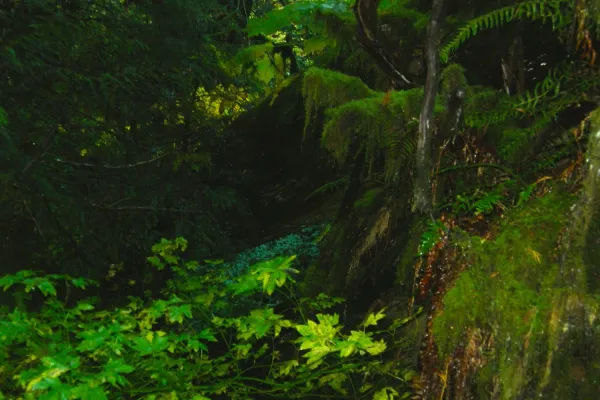
In the absence of reds and yellows and pinks, there is a mosaic of green against green. A vine maple with bright mint-green leaves grows horizontally out of the bank, leaning gracefully over the creek. Oregon grape with its glossy dark serrated leaves springs from the duff. There’s newly sprouted poison oak, shiny too, with its shapely oak clusters. New growth is everywhere: the bright tips of the Douglas fir branches, the swordfern’s unfurling tips.
Eleven winters ago this pretty, well-behaved creek became a monster. Swollen with stormwater and snowmelt, it plucked boulders and logs from the mountainside and carried them downstream in a torrent, eating away at its banks and depositing its load here, creating a broad gravel bar where a narrow ravine had been before. The high water line, marked by dangling roots, is still visible on the far bank. Trees torn from the banks lie across the creek; one massive Douglas fir now makes a sturdy footbridge.
As I lift my head, I see the shaggy tops of ancient firs on the opposite ridge, straight and tall and eternal. Cedars with their scaled branches cluster close to the creek. The pale lichen draping the firs along the trail give this riparian stand the ambience of great age, but that is deceptive. Everything is dying and renewing, nothing is static, not this creek, not these boulders, not this bank, which could crumble into the river given another 100-year flood.
If this creek could change its course and reshape its banks so dramatically in just a few hours, who can predict the changes that 200 years might bring?
Tomorrow I will learn whether the pert green oak clusters carry the poison that could cause my skin to flower in a painful rash.
Continue reading Durbin’s “Reflections on Change, Natural and Otherwise: A Forest Journal.”