Purity and Change: Reflections in an Old Growth Forest

I caught hold of a splintery old root and hoisted myself up onto the gray log looming beside Lookout Creek. At over five feet in diameter this fallen Douglas fir was a tricky tree to climb, even sideways. But having caught a glimpse of an invitingly concave spot up top—just where the buttressed base had once arched out into the duff of an Oregon forest floor—I was determined to make it the viewing station for my first survey of old-growth here in the western Cascades.
During the flood of 1996 the massive log on which I now sat had been scoured to the smoothness of driftwood and then wrenched perpendicular to the current. I settled in under my broad-brimmed rain hat and my slicker, watching as the ancient forest of Douglas fir, western red cedar, and western hemlock all around me inhaled the steady rain. There seemed no limit to its lung capacity. Even when the sky cleared after a couple of hours, the thick moss draping over the undercut southern bank continued to trickle and drip for the rest of the day—a brown-green sponge through which the forest’s effluent perked into the creek for its winding passage to the McKenzie River.
Lookout Creek drains the H. J. Andrews Experimental Forest, a 16,000-acre watershed within the Willamette National Forest that was set aside for ecological research in 1948. Over the past six decades, this research station has become the world’s leading site for long-term studies of old growth. Geomorphologists run experiments here on erosion and on the dramatic surficial shifts that can occur on slopes under the influence of rain. Later on in my week at the Andrews, where I was participating in the Spring Creek residency for writers, I was lucky enough to see the celebrated, 100-meter-high “debris flume” in operation. Numerous scientists and field-assistants (including a small contingent from Switzerland) had assembled in order to watch tons of well-watered soil, gravel, and cobbles slide down the walled ramp past cameras and electronic sensors and then spill out onto a broad concrete grid. The material sorted itself on the way down, so that the larger rocks and gravel separated into levees on either side of the muddy main current—containing the flow and thus promoting a longer course of travel before movement finally ceased. Such a dynamic was subsequently described to me by University of Oregon geologist Kathy Cashman as “optimization,” a process whereby non-biological phenomena attained their maximal extension in a kind of dialogue with gravity and the laws of physics.
Another ground-breaking area of research at the Andrews has been on the “mycorrhizal” association of roothairs and fungus in the upper level of the soil. An intricate network develops over many years, in which nutrients are not only transferred upward from decomposing matter in the soil but are also conveyed from tree to tree. The biotic richness of old growth derives to a significant degree from the mycorrhizal web. When a fire or other natural disaster occurs, it is this below-ground community that speeds recovery. The swiftness with which even forests buried under thick layers of ash after the explosion of Mt. St. Helen’s have now recovered reflects in part the powerful functioning of fungal-roothair networks as a “biological legacy.” Even more than the ancient trees themselves, these humble if generally unseen associations both sustain the character and protect the future of old-growth communities.
Immediately adjacent to the Andrews is a 1993 clearcut I was to visit on several occasions during my week. Every tree had been removed, with no apparent concern for the certainty of erosion on such a steep slope. I couldn’t stop asking various people I met in Oregon if there were no criminal penalties for such heedless practices. The answer, it seemed, was no. Having denuded the site, the logging company then burned off the slash and applied pesticides to hold down brush. Fifteen years later, there was little evidence of regeneration. The barren slope offered a shocking contrast to the forest flourishing just across its northern boundary, in the National Forest. Even more sobering, though, was the condition of the ground itself. Beneath thick brambles that made walking a painful challenge, the soil itself was as dry as powder. There was nothing there to hold moisture and foster the survival of a mycorrhizal network or any other form of biological legacy. This clear-cut illustrated, fundamentally and grievously, the eradication of old growth’s millennial richness.
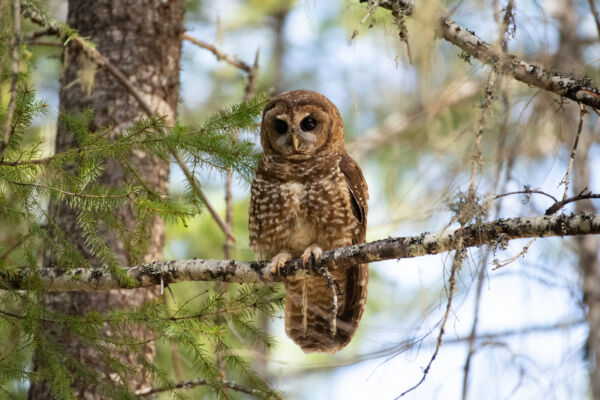
If subsoil research had led to the most fundamental scientific discoveries at the Andrews, however, the understandings gained here about spotted owls have without doubt been the most politically influential. The juicy vitality of old-growth woods like these was nearly logged out of existence over the past century. Vestiges totaling about 5% of the original Oregon forests did ultimately receive protection, though, because of a 1990 decision to list spotted owls as threatened under the Endangered Species Act. A series of studies had concluded that these owls could only survive in old-growth habitat, and the resulting “threatened” listing led directly to the establishment of a Northwest Forest Plan in 1994 and to a new system of forest reserves (LSR’s) on public lands. Thus, in addition to depending for their own continued existence on the communities of lichen-hung giants like those that rise above Lookout Creek, the spotted owls also thus became their main protectors.
Politically as well as ecologically, spotted owls and old growth might be said to have developed a symbiotic relationship. From the Pacific yew, western hemlock, and western red cedar growing so densely in the lower elevations of the forest through the 500-to-800-year-old Douglas firs towering above them, these woods are so dense and self-enclosed that there’s no way for predatory great-horned owls to horn into the spotted owls’ niche. Old growth also abounds in the insect and fungal life that support the spotted owls’ own favored prey, like northern flying squirrels, bushy-tailed woodrats, pocket gophers, deer mice, western red-backed voles, and red tree voles. And even though private old-growth has continued to disappear in Oregon, big enough patches of public old-growth were secured to provide adequate habitat for this distinctive, affiliated bird. It was a triumph of conservation grounded in compelling ecological research.
***
It turns out, however, that the spotted owls have another problem, and one that seized my attention as a visitor to the Andrews Forest who had come from New England. At the beginning of the twentieth century eastern barred owls began making their way across Canada to the Pacific and then extending their range southward along the coast. The second-growth woods following upon nineteenth-century timbering seemed to facilitate their migration. They are now more numerous than spotted owls in British Columbia and Washington, and their numbers are increasing in Oregon, where they have been resident since 1947. One factor in the newcomers’ success has been their ability to colonize a wide range of habitats, including managed forests. They can blanket the Northwest woods, while spotted owls rely much more exclusively on the attributes of old growth—where they must also now compete for their traditional niche.
Though significantly smaller than the great horned owls, barred owls are still a bit bigger than the native owls of Oregon’s old growth. A research poster in the Andrews headquarters informed me that males of the spotted owl average 582 grams and females 632 grams, while the corresponding figures for the barred owls are 637 and 801. In addition, barred owls have also proven themselves to be more aggressive in competing for territory. A research report for which Steve Ackers of the Andrews “owl team” was a principal investigator concluded that “In some areas where barred owls are particularly numerous, survey data suggest that spotted owls are gradually being displaced by barred owls and forced into marginal habitat at higher elevations. . . The mean probability of pair occupancy decreased by approximately 5% with the presence of barred owls.” It’s also now been established that spotted owls and barred owls have begun hybridizing within the old growth forest. Where the characteristic hooting of the spotted owl is the four-note sequence hoo—hoohoo—hoo and that of the barred owl is the nine-note hoohoo-hoohoo—hoohoo-hoohooaaw, the hybrid birds typically have a five-note call: hoo—hoohoo—hooaaw.
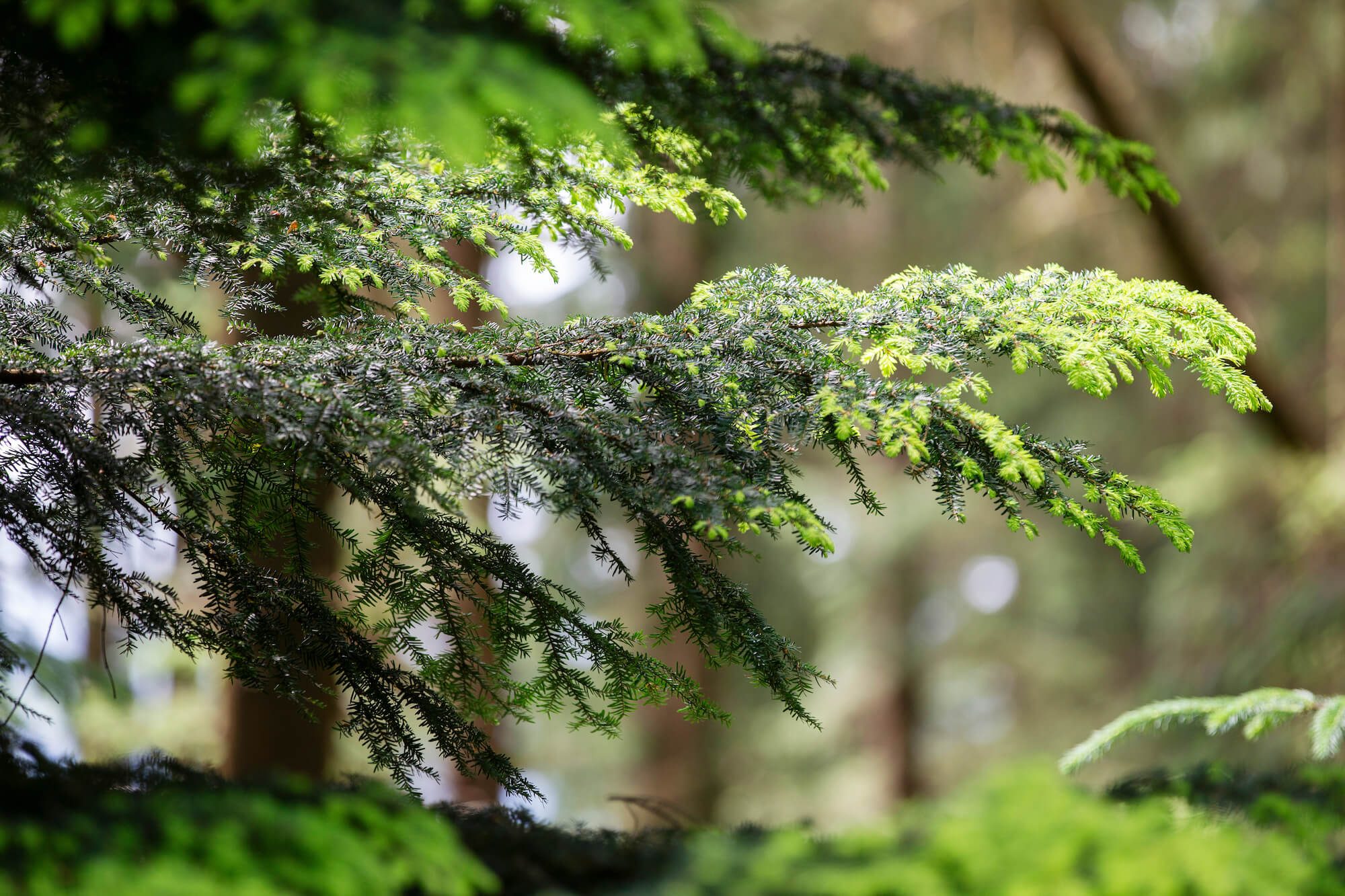
Upon first arriving at the Andrews forest I had happily noted the existence of familiar plants on the floor of this remarkable and, to me, exotic landscape. White trillium was everywhere, along with yellow violets and spring beauty—just in the season when those same species were flowering in the woods of Vermont. Even in the dramatically different arboreal community here, I was struck by superficial similarities. Douglas firs, so much taller and weightier than any tree ever growing in Vermont, and with their sculpted trunks providing habitat for whole ecosystems of mosses, fungi, lichens, and insects even while still alive, nonetheless had the characteristic fir needles. The Douglas fir is not classified as a true fir in fact, but placed in a separate genus of its own. Nonetheless, its short, soft, flattened needles, with occasional twists that give them a lacy look, strongly resembled the needles of our balsams. Similarly, the western red cedars—with their columnar trunks sometimes rising to 60 meter and thus over three times taller than cedars in our part of New England—were still clad in flattened, slightly scrappy bark highly reminiscent of the bark of white and red cedars that thrive in wet ground and around ponds throughout Vermont’s Northeast Kingdom.
Such affinities only made the presence of barred owls here more problematic. They were competing with the icons and protectors of old growth. In their hybridization with the spotted owls, too, they were blurring the definition of Oregon old growth. Above the desk in my living quarters at the Andrews was a colorful poster showing the characteristic plants, animals, trees, and birds of a “Pacific Northwest Old Growth Forest.” Right there in the foreground, looking dramatically back over its shoulder, was a spotted owl, with nary a barred owl in sight. The fact remained, though, that barred owls are birds with positive and highly personal associations for me.
Our family operates a sugarbush in the Green Mountain foothills of Starksboro, Vermont. In the summer we work together there to bring in the sugarwood. In the winter we walk the trails checking out our saplines. And in early spring we gather with friends in the sugarhouse, lobbing long splits of wood into the evaporator every few minutes to maintain a high boil as we reduce 40 gallons of sap to one of syrup. There are black bears denning in the upper reaches of our woods each winter, imprinting the smooth bark of beeches with semi-circles of dark dots when they emerge in the spring and dig in their claws to climb after the beech-nuts. Fishers stitch their weaselly tracks across the snowy slopes and squeeze under fallen trees. Coyotes launch their piercing calls across our bowl of land when night comes on. At dusk hermit thrushes sometimes sing here, too. But the soul of these woods is the barred owls that hoot around us in every season. Especially when we’re boiling through the night to finish up a last run while the sap is still fresh and cold, the barred owls are the midnight voice of the forest. The high, chiffy notes with which they announce themselves are inseparable from our family’s excitement around the roaring fire—heat at our faces, cold air at our backs from the open door of the attached woodshed. The barred owls furnish the music in this familial ecotone, our border zone between village life and the larger life of the woods, “lovely, dark, and deep.” But they mark another ecotone here in the Cascades, between a habitat that deepened over thousands of years and new challenges to the inhabitants of old growth in a fragmented and interspersed landscape.
They represent an alarming change, like the barberry, honeysuckle, and Japanese knotweed edging into the woods of Vermont as winter comes later and ends earlier each year. Those exotic invasives take advantage of fragmentation in the forest cover of New England—spaces where stands can take hold that never could have found a foothold under more continuous cover. The warming trends that make our woods more hospitable to such species also allow for beetles, ticks, and caterpillars that had previously been frozen out by the depth of our winters. Yet another factor in the changing composition of our forests is the overpopulation of deer. They typically prefer native browse and seedlings to the invasives and thus give the newcomers even more of a competitive advantage.
***
The fact of the matter is that I never saw or heard an owl of any sort during my stay at the Andrews Forest in early May of 2008. The winter just past had been a rather long, snowy one (as had ours in Vermont), and the researchers still were not able to get into many of their main study sites. But that hybrid, phantom hoot (Hoo—hoohoo—hooawwh!) kept ringing in my ears as I learned more about this Oregon old-growth and compared it to our forests back home in Vermont. It made me think about how our sustainable forestry group back home, Vermont Family Forests, is trying to make wilderness our criterion for management and stewardship. Preservation of standing snags, protection of woodland seeps and other fragile habitats, limiting the number of roads and keeping them away from hillsides, and avoidance of synthetic pesticides and whole-tree harvesting were among the elements of such an approach. This means that when exotic invasives do appear we rely upon a combination of hand and mechanical removal, selective thinning to promote a more diverse forest with a more robust canopy, and measures including both building exclosures and the promotion of hunting to keep deer from being such a factor favoring the invasives.
Even so, it is inevitable that our forests, like all forests, will change. What’s more, without major pesticide programs, we’ll definitely have to get used to seeing knotweed along some of our streambanks and buckthorn in our newer and lower woods. They will be a constant, and not always welcome, reminder that the natural beauty and balance we prize in our little state are altered by the same warming sky and the fragmentation of forests that affect the rest of this lovely, tilting planet. The challenge facing us is thus not only ecological but also emotional. How can people who love Oregon old-growth, the returning forests of northern New England, or some other rapidly changing landscape keep from becoming downcast?
When I sought out the owl team at the Andrews to talk about the barred invaders, however, I was struck by their measured and philosophical perspective on those birds’ direct competition, and interbreeding, with the indigenous spotted owls. Steve Ackers, head of that team, told me that he actually thought the competition was starting to level out, for a couple of reasons. One was that, when there’s truly old-growth density the barred owls are simply not quite as deft in making their way through the woods at night. As he put it to me, when they call in the spotted owls they arrive with a nearly silent whoosh. But when the barred owls come “it sounds as if someone just threw a football through the branches.” Even the hybridization doesn’t blur or weaken the spotted owls’ population as dangerously as they might have assumed at first. The hybrids tend to back-breed with the barreds much more than with the spotteds, returning, in effect, back into the newer stock. In the long run that pattern may make them even more competitive. But it will also make them more and more like the owls with which they are competing.
***
There’s an interesting connection (though not exactly a parallel) between the incursion of barred owls in Oregon and the belated replacement of wolves by coyotes in Vermont. We haven’t had a resident wolf population in many years. As thick forests have returned to northern New England and the Adirondacks since World War II, though, we have finally regained the habitat that would support wolves. There’s been a great deal of talk among wildlands proponents of reintroducing wolves here, or of taking steps to protect the ones that cross back over from Canada. But wolf scientists have increasingly begun to argue that such policy decisions are beside the point. With the decline in hunting and trapping, populations of deer and beavers, two of the eastern wolves’ main traditional prey animals, have exploded. So there’s an attractive open niche for a top-predator, and it’s finally being filled—but not with exactly the animal that used to occupy it.
Just as barred owls have been traveling west over the past century, coyotes have been making their way east. By the time of reaching northern New England they have often interbred with Ontario gray wolves. We now are seeing larger and larger, grayer and grayer coyotes. They can still act wily and opportunistic, like coyotes in the ravines of Malibu and the foothills around Albuquerque. But they can also hunt in packs and bring down deer.
My wife Rita and I sometimes stay at a cabin in the Northeast Kingdom town of Craftsbury that’s on Little Hosmer Pond. It’s a shallow enough body of water that it freezes early and solid each winter, so that for several months of the year a local herd of deer can cross it going west in the morning and recross it to the east each evening. Twice in recent years we’ve listened to the yips and exultation as a pack of wolfy coyotes have dragged down a straggler from the herd. On each occasion, upon skiing out to the center of the pond the next morning, we found the skeleton and hide of their prey. Over the next couple of days the hide disappeared and then the bones were disarticulated. At the last there was just a pink splotch fading into the snow where nourishment flowed out of the herd and into the life of the pack. This northern ecosystem is once more finding the predator it has needed.
The uniquely thorough-going and sophisticated research of scientists at the Andrews has disclosed a deeply grounded and intricately interwoven world, in which a wide array of species, including the spotted owl, the bushy woodrat, the nitrogen-fixing lichen Lobaria, and the truffle each play a crucial role. As long as the underlying health of the whole community remains, it may be possible for barred owls, as for coyotes in our Vermont woods, to step into the long dance without disrupting it. But the resilience of the forest itself is vulnerable, and must be protected at all costs. The practices exemplified in the 1993 clearcut, like the widespread use of pesticides even within a more discriminating, single-stem approach to forestry, can lead to simplification and even collapse of the underground portion of what the writer Jon Luoma has called “the hidden forest.” The arrival of barred owls need not in itself spell disaster. It can simply be one among many alternations and accommodations in the ever-meandering current of energy and resources through a forest.
***
One advantage of taking a perspective on the forest that is grounded in biological health yet flexible about shifts in the specific biotic community is that it guards against too obsessive a concern for purity. Not only is avoidance of such obsession in accord with the dynamic vision of the science of ecology, but it also accords with a new, more inclusive approach within the environmental movement. The last century and half have been a grand era in America for conservation. National Parks and National Forests were founded under the inspiration of figures like John Muir and George Perkins Marsh, and have become essential to the culture of America and the world. In retrospect, though, there has also been a general emphasis on purity within many of the environmental achievements of this period, leading many to sense an exclusive or privileged character in the conservation movement. The 1946 Wilderness Act with its emphasis on pristine and “untrammeled” landscapes, the Environmental Protection Agency, and the Clean Air and Clean Water Acts all sought to prevent destruction or pollution of landscapes and biological systems. We’ve now come to a point, however, where such an emphasis needs to be balanced by a more inclusive, diverse, and celebratory form of advocacy.
When pursuing environmental projects, it’s especially important to avoid evoking an Edenic, pre-Columbian past against which present realities have been tried and found wanting. In fact, this need has been reinforced by ecologists’ own turning away from such concepts as “climax forest” to a more cyclical perspective on ecological balance. Similarly, when meeting the challenge of exotic invasives it would be well to beware rhetoric that resembles that used by anti-immigrant groups! My growing discomfort with the language of environmental purity has been heightened by reading Simon Schama’s Landscape and Memory. Schama points out that, for one seeking to identify a truly green regime in modern history, the Nazis would be a good place to start looking. They had a vision of Poland, for instance, as a huge national park roamed by native bisons and wolves. There was just the detail of removing almost all the people to make that dream come true. I am certainly not calling environmentalists Nazis (though others have done so). I’m a lover of wilderness who identifies strongly with the environmental movement. But I do believe that it’s time for us trade in as much of the language of purity, exclusion, and restriction as we can manage, in order to dramatize a shift to the vocabulary of inclusion, diversity, and community.
The local-food and urban-gardening movements have been two promising initiatives in this regard. Rather than being so quick to engage with non-environmentalists in a confrontational way (“Climb out of that SUV slowly and keep your hands where we can see them”) we should offer an invitation wherever possible (“Just taste this”). Farmers’ markets, whether in Eugene or in Middlebury, help to support the continued existence of old-growth forests in the Cascades and second-growth woods in the Green Mountains. They celebrate the place of sustainable human communities and responsible agriculture within a larger world of healthy water, soil, plants, and animals. They stand against the assumption that there’s nothing in this lovely world but commodities to be bought, sold, and consumed by economic interests already planning their exit strategies from one landscape and their extractive ventures elsewhere.
We need to do everything we can to protect native inhabitants of an ecosystem, like spotted owls, while also paying attention to the plight of rural Vermonters being pushed off the land, of city-dwellers cut off from the source of their food, and of villagers around the world subordinated to global economic systems beyond their control. When observing both ecological and social change, we need to ask what broader trends lie behind these local changes. What are the implications of such developments both for existing species and communities and for necessary alterations within the practices of our own families? Ecological and social newcomers are messengers from a turning world. The question with which they arrive is always the same: how we can serve the underlying health of our world while gracefully acknowledging the inevitability of change?