Child of a Salmon Star
I am the salmon in the deep pool.
Amergin (The Song of Amergin, 1530 BCE)
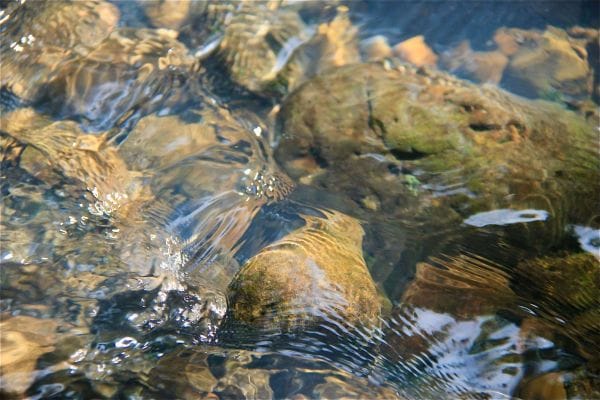
Liquid winter Sun casts long morning shadows across Horse Creek on a cloudless January day in the old growth forest of the western Oregon Cascades. I make my way upstream toward a broad side-channel where as many as thirty spring Chinook salmon spawned about four months ago. Near the outlet of the channel, a rapid spills through a tangled logjam into a mirror-smooth pool where no trace of current can be seen: a paradox of moving stillness. The water curves over a pair of boulders at the pool’s mouth. The sparest hint of flow bands their contours giving them the look of upturned pottery, glazed gold.
Born as a ripple between the boulders, the growing wake of a nose wedges into the pool. I freeze. The play of light on slicked fur and the sinuous weaving and rolling of the form are so fluid that the river otter looks like an animated sculpture made of water itself.
After a moment of splashing and twirling within the logjam, the otter clambers out of the channel, lopes up the far bank to the top of a snowdrift, and belly-slides back down. It pours itself into the pool and appears to transform wholly into an expanding set of shimmering rings. They fade like last hints of a fleeting thought that came for a moment into the mind of the creek, a mind that thinks otters in light and water.
Stillness returns and I push on, heart lightened. Gentle eddies swirl over river-bottom redds that were flurried with fins and glossy bowed backs the last time I was here. The comparison of memory with the present registers their absence. I miss the salmon.
I have to remind myself that they are still here, in a different form. The hope that I might glimpse Chinook fry is what has drawn me to the water’s edge. I have no idea if it will be possible to spot the tiny fish flitting holographically among redd rocks, but the timing suggests a chance.
I approach one swathe of bankside stones that was particularly busy during the warmer months. It is located just upstream of a fallen Douglas fir giant, which served as my blind in September. That day, peering over the prone trunk, I watched half a dozen two-to-three-foot-long fish staked out above this pad of submerged gravel. How many eggs did the females bury here? How did those thousands of fragile worlds fare during the swell of snowmelt and rain that came when they were less than two months among the stones?
I clamber over the log, move slowly to waterline, and crouch as low as I can to scan the current.
It’s plausible that a whole school of little swimmers is hovering just under my nose. The cryptic sheen of fish flesh is one of the more astounding adaptations I know of. Trying to spot fingerlings in moving water, with all its distortions and false-positive illusions, could take hours. If the tiny fry are here at all.
There is a fairly broad window of time over which salmon eggs hatch. Emergence in one nest might take place a month or more before or after it takes place in another in the same creek. And the hatchling alevin remain tucked in the seams of negative space between redd stones for about two weeks. They survive during that time by feeding on reserves stored in their distended yolk sac bellies. Then, when the last of these nutrients are used up, they ascend as fry into open water where they feed and grow until their second spring when they become smolt, the oceanward travelers.
The fry here may have already risen and dispersed into quiet sheltered spaces among root masses, logjams, or other places less exposed than their birth redds. I could be looking for them in the wrong spot. Or the eggs might not have hatched yet.
I wait.
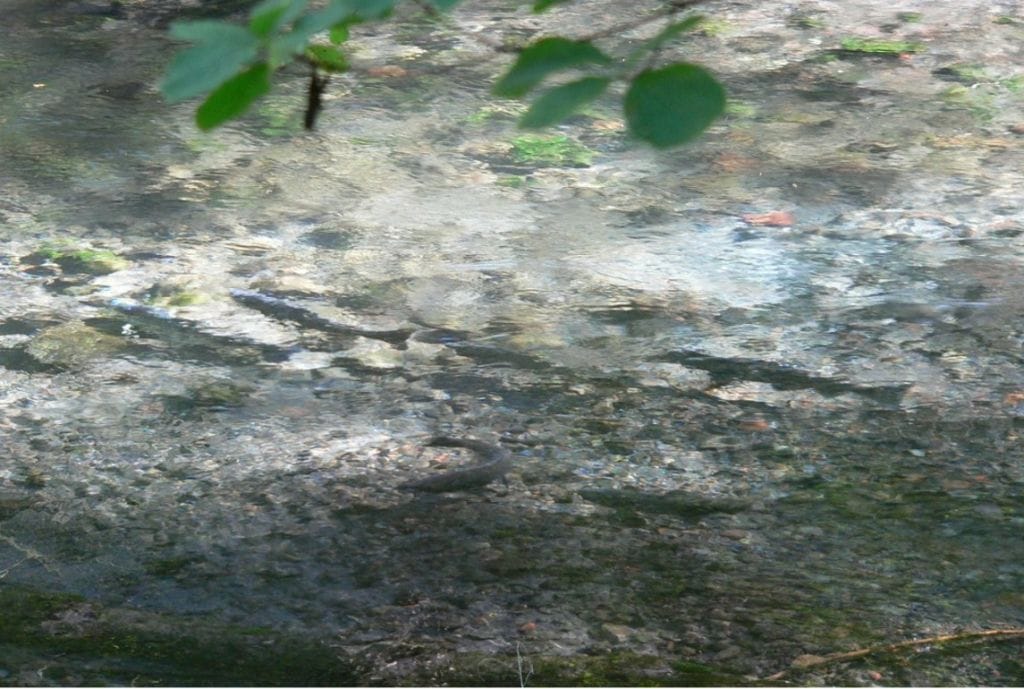
First my mind, then my eyes, wander. A few feet downstream, a curve of white, just a little too pale to be a beaver-peeled stick, arches up out of the creek bottom, rising from one smudge of algae and setting in another. It is a fraying rope of vertebrae, a salmon spine with loose needle ribs swaying in the current. Ghostly threads of sinew barely hold them together. The softer meat has long been transformed into microbe, insect exoskeleton, dipper song, river otter, and many other lives via the incomprehensible energy pathways from mouth to mouth to mouth.
These pathways all eventually trace back to the Sun.
***
For some 4.5 billion years, the Sun has been pouring out a river of energy. Those umbilical rays feed the whole vast menagerie of Earthly life, even deep-sea organisms, like the famous hydrothermal vent tubeworms, who receive none of the energy directly. The push and pull of solar and lunar gravity against Earth gravity quickens the molten depths far underground, generating tectonic heat that wells up along fault lines on the ocean floor. Lava extrusions provide the warmth that fuels, and the structure that supports, the isolated pockets of life in this otherwise frigid, black, and inhospitable marine cosmos.
So different is vent-dependent life that, unlike all other known forms, the omnipresent sulfur, rather than the locally-rare carbon, serves as its most basic chemical component. It is literally a different expression of aliveness, one in which clouds, rain, rivers, and Sun are beyond detection.
Yet tubeworm and salmon share a certain kinship: salmon exist in time the way the organisms of the abyssal seams exist in space. The touch between adult salmon and their young, like the touch between tubeworm and Sun, is indirect. They never meet. But there is a vital connection.
For the salmon, the intermediaries are mountains, water, and light. These are their surrogate parents, these so-called non-living, inanimate forms which feed and rear the fish from egg, to alevin, to fry, to smolt. The mountains shelter them. The water feeds them. The Sun moves them all.
***
Every September, the healthiest run of Spring Chinook salmon in the Willamette River basin begins to spawn. By that time, the great fish have been in the river since May and have not eaten in months. While this follows a logic of energy conservation, on a deeper level they are serving as a net energy source for the river, bringing with them the bounty of the ocean stored in their very flesh. In other words, they come to feed the mountains rather than feed from the mountains. In so doing, their young are born into a world ecologically wealthier and healthier than it would otherwise be. In turn, to the multitude of eggs they tuck into a stony womb, the landscape itself becomes the nurturing parent.
For salmon, mountains flow like water. Each fish is well-adapted to riding the currents even though no parent has shown them the way and they accumulate only about five years of life-experience before heading inland to spawn and die. Salmon wisdom is of a different order than ours, learned and remembered in a different mind.
Could it be that the brains within salmon skulls are slight because mountains, rivers, and forests serve not only as their wombs, but also as their gray matter? If so, it might be more accurate to say their bodies swim around inside their minds, not visa-versa as animal physiology textbooks, which equate mind with brain, would have us believe.
The knowing-how-to-be-in-the-world that most modern humans—who may live fifteen times longer than a Chinook—only glimpse is what salmon are born into.
As I settle in by the quiet channel on this January morning under the stretched light of winter, I feel that humans are also born into it, as are all forms of life from tube worms to river otters. The key for us humans is to open ourselves to the level of memory where knowing-how-to-be-in-the-world is stored. And that means opening to the world itself.
***
In the world by the channel, here, now, there is only this string of wet bones in the flow and no fry that I can see, but the place sings salmon in every other way. Salmon are written in every feature. And I too am in the mind of salmon, a thought that came into the consciousness of the creek.
To have this sense, I have to redefine aliveness in broader terms than I have before. It starts with the water.
Water is essential for life. I’ve often heard these words, especially in reference to the search for life on other planets. Yet, I’ve rarely heard the next sensible thought: that water is alive.
Before life as we currently recognize it was born, there was a process under way that displayed the primary qualities we associate with aliveness: dynamism, activity far from equilibrium, self-direction, and self-replication. We call it the hydrologic cycle, the wheel of water.
Organic organisms are its offspring. We are born from, and are included in, its ceaseless circulation. The water that composes 80% of a person is simply water flowing through a different kind of channel than that which buoys thrashing salmon and feeds oxygen to eggs hidden in a gravel nest. Water makes up most of the life-blood that courses through veins not only of flesh, but also of bedrock, cobbles, pebbles, and sand, the vessels of our shared body of Earth.
Our aliveness derives from the aliveness of water. We are water in human form. Chinook are water in salmonid form.
Paradoxically, salmon display their attunement to this sense of aliveness most clearly at the time of their death. Salmon spawn, then dissolve like twilight, melting back into their liquid world and the substrates of the creek. They feed the greater ongoing life of the land with the bulk of their exhausted bodies knowing, in their way of knowing, that salmon perpetuation depends on it.
Much of the energy that the creek uses to ‘think’ salmon fry comes from the energy released in its ‘forgetting’ salmon adults. This maintains the broader continuum of salmon, a continuum that, with the recognition of the aliveness of water, is so expansive and inclusive it can be traced beyond the age of the Earth. The life-way of salmon is a life-way that predates the planet. Even the Sun.
***
Some five billion years ago, a giant star went supernova and dissolved into the river of time. Her strewn bulk coalesced into a smaller star and thousands of other celestial bodies: eight planets, dozens of moons, countless asteroids, comets, rings and particles of dust. Like salmon, the parent star gave all of herself to her offspring, offspring that would not meet her because they are her, transformed.
Her material elements—many essential for life yet nonexistent before her death—were not all she passed on to her children. She passed on her way of being as well. It is recalled in the cycle of salmon.
Through salmon we can see that it is a cycle that emphasizes life; death is imbedded within the context of a greater process of living. Salmon display a profound determination for presence—a moving stillness, a drive that goes beyond the goal-focused notion of purpose. To perpetuate in the manner of stars. Theirs is a life that embodies patterns billions of years old, and wisdom written with a cosmic sweep more durable than planets.
***
There are many stories about how we, humans, salmon, all the living, came to be. The creation myth into which I was born, a myth of exceptionalism, superiority, and separation from the rest of the community of life, has been building on itself for some six to ten millennia.
Here, by the creek, in the forested mountains, everything around me speaks not of creation, but of procreation and birth. Births represent profound transformations that can be called beginnings, but avoid the tricky philosophical conundrums associated with the idea of creation—the willful conjuring of something from nothing by an outside source.
Our primary instruments of creativity—our hands—evolved for the arboreal existence of our pre-human ancestors. That we used them to make things once we left the trees does not mean we ourselves were made by some outside hand. That belief reduces our bodies to mere dead mechanisms, requiring an explanation for the animating quality—the soul—the ghost in the machine.
What if we were to allow that the universe is self-born, like an ocean in a cosmic water cycle, an ocean beyond which we cannot see any more than the life of the abyssal vents can see the stars? What if we understood that the level of transformation that represents the birth of the universe is such that no direct evidence of the parent remains because, in the way of Sun and salmon, the parent literally gave its all to its offspring?
How might such a view alter our sense of who we are? And how might it inspire us to comport ourselves in the world?
***
Even though I fail to find any fry flitting among the stones of the channel, the enveloping presence of salmon that I have found calms the urgency I felt when I arrived. I stand and begin shadowing waterline back downstream. At the mouth of the channel, the root ball of a western red cedar hangs suspended in the air, levered free of the earth by its toppled trunk. A deep opaque pool fills the bowl of earth where the tree once stood.
Contouring the curve of one of the cedar’s wide roots is another string of salmon vertebrae. They are arranged as if still threaded onto spinal cord, but there is only air between each round bone. A cushion of moss holds them as if they were still integrated within the body of the fish.
Further down the trunk, a moldy mound of otter scat hints at who, in October, may have hauled the still-meaty carcass from the water to this perch to feast. Even while the otter fed, other smaller mouths were digging in, stripping the carcass down to the white puzzle I see now, a puzzle that could not have been more carefully pieced together, even by a master artisan’s hand.