Field Notes from the Digital Forest

April 29, 2019, Day One
The drive to Andrews from my home is short and familiar, on a winding highway along the McKenzie River. I drive slowly, passing farms and the diversion channel in Leaburg where the river is controlled; the tiny Heaven’s Gate cabins that cling to the edge of the river’s banks, asking to be swallowed by the next flood stage; and a clutch of popular riverside wedding lodges where I can count on both hands the friends I’ve known that married there, ticking off the unions that have since dissolved. Finally, I veer left just past the Christmas Treasures house, a local landmark where dozens of bearded Old Man Winters hold court.
It is a road I do not remember having taken before, though surely I must have. I have several memories of the Andrews, the first of which from some twenty years ago on a geomorphology class trip in the heat of summer to see the avalanche chute, a concrete plume that rises hundreds of feet up a steep slope and down which even today geologists chuck myriad types of debris to see what happens. In truth, the chute is a relic from a different time, rudimentary in conception and almost obscene in the way it cuts through the forest. It is also utterly unique in the world and unlikely to be duplicated—one would be hard-pressed to gain approval of such an invasive and industrial, albeit good fun, research project now. It was my memories of this strange, incongruous feature in the forest that drew me to apply to the residency.
On my way I stop at Blue River Reservoir, a popular summer recreation spot that is the gateway to the Andrews. I have it all to myself save a freshwater newt playing across the pebbles in the shallow shoreline water. The water is deep blue and glassy still, no bugs or fish disrupting its surface. The tree-covered mountains rise up sharply behind it and the world is still. It smells like home.
I arrive, check in, and go the “Green House”, the only modern, non-forest service brown or seventies construction- style building at the headquarters. It has concrete floors, wood-slab furniture and is clean and built to impress with large windows that look out to a graveled maintenance yard and repair shop and several other residences. Through them one might squint and think themselves in town.
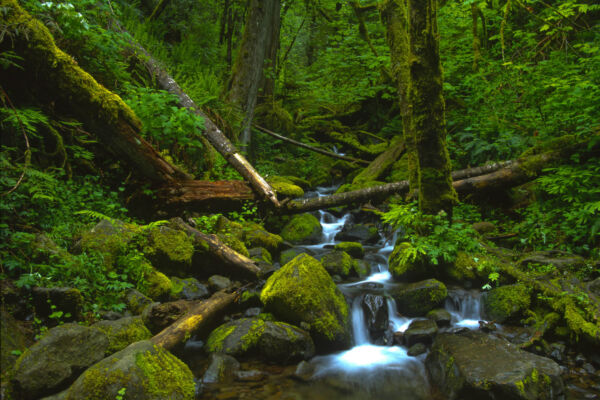
In the afternoon I walk. The Andrews is a working forest and it shows. Besides the main building and residences there are the maintenance buildings, the monolithic avalanche chute, vehicle wash stations, picnic areas, and roads upon roads. In the forest there are stakes with thermometers, flagged trees, pipes and buckets, and everywhere freshly cut logs- a visible effort to clear roads and trails of the hundreds upon hundreds of trees that fell in a recent historic snow storm. They lay now in piles, already dry and seemingly waiting for a stray spark to begin their conflagration. I wonder if this is the last spring before it burns. Eventually, I pass the educational trail with its numbered markers. I was told that each child is given an iPad so they can watch an interpretive video at each location. I imagine rain-soaked groups of school children staring into screens at a virtual ranger. At each marker I stop and look, searching for the point of interest, but without an iPad I am at a loss. It could be anything, the fallen log, dog-tagged as part of some research project, the nurse log covered with a carpet of thick, fern-like moss, the ancient cedar tree towering above it all.
Back at the Green House, my every movement echoes against the concrete space. Outside military planes fly low overhead and there is a constant roar of chainsaws.
Read more from McConnell’s “Field Notes from the Digital Forest.“