Out of Time
Soggy Again
The alarm on my wristwatch rang this morning, as usual. Seven o’clock. But today I responded in a different way than I normally do. I stopped the insistent beeping, leaned out of bed, and hid the watch in one of my briefcase pockets, out of sight. Thus began my little experiment in timelessness, an experiment planned ahead and expected to last three days, approximately half of my stay in the green and misty forests of the central Oregon Cascades.
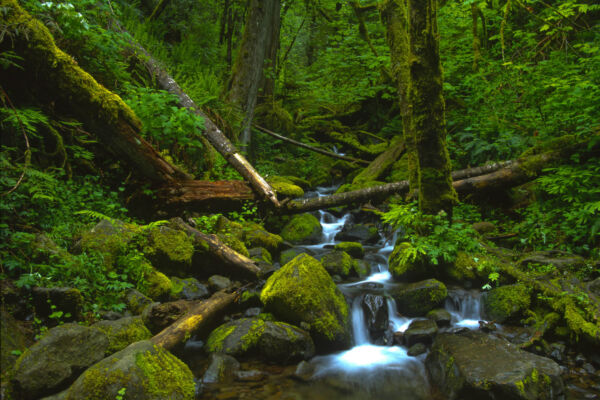
I am visiting the H.J. Andrews Experimental Forest, about fifty miles east of Eugene. These are the woods of my childhood, familiar and foreign in peculiar balance. The bushy greens of tilting pines are a familiar sight that returns me to the years of elementary school, junior high, and high school, before I went away to college. Vivid, impressionable years. Years of comfort, family, and adolescent struggles. In some ways this is my original landscape, my originating landscape. This is the landscape I still see in my dreams at night, although for decades now I’ve called freeway-strewn California foothills, narrow buckling New England streets, rural muggy small-town Texas, and brilliantly brown Sierra peaks “home.” For a week now, I’m back in Oregon, back in rainy green, dwarfed again by widow-making firs, soggy again to the bone.
Prerelevant
I arrived at “the Andrews” yesterday at midday. Scheduled to meet geologist Fred Swanson and poet-essayist-housebuilder-gardener Charles Goodrich at noon, I pulled into the headquarters parking lot at precisely five seconds after 12:00, fastidiously punctual even for me. We spent the afternoon chatting over lunch in the field station library. Fred demonstrated a geologist’s penchant for story, relating the history of the research performed at this site and going into detail about his own special interest in landslides and other natural catastrophes and how ecological systems respond to such events. I wasn’t taking notes, but I tried to retain as much of this information as possible, keying in on particular phrases. Windthrow. Longterm. Temporal mindbending. Prerelevant.
Impressed by the hundreds of experiments that have been conducted at the Andrews since its founding in 1948 and by the idea that the nearly 16,000 acres of the forest are full of monitoring devices and research plots, I wondered whether there was a clear plan for each of these studies or whether some of the data was simply being collected in hopes of later determining its relevance, its meaning. Fred explained that it’s often the case that scientists gather information that doesn’t seem relevant to issues of the day but that later takes on meaning.
That later takes on meaning. How often do we have the luxury of gathering information, storing it, bringing it out again on that “rainy day” when we need answers. Sitting in the Andrews library, a repository of data about the myriad studies of stream flow, biodiversity, and the rotting and regeneration processes of this temperate rain forest, I am straining to hold on to the information flooding into me through Fred’s narrative, metaphor-rich language. I want to know this place. I should know this place. This is the place of my youth, and yet I’m a stranger.
I continued to wear my watch throughout the afternoon and evening. Kathy Moore and her husband Frank and their colleague Dawn, the mother of one of my former graduate students, showed up to accompany us to several longterm ecological reflection sites and to dinner. The afternoon was one of companionship and conversation. Time still dominated. “What time is our reservation for dinner?” “I guess it’s time for the Corvallisites to hit the road.” I returned to my apartment, read myself to sleep, and plotted my escape from time the following morning, promptly at 7:00.
Continue reading Slovic’s “Out of Time.“