Reflections on Thrush Songs, Newt Tracks, and Old-Growth Stands of Trees

The songs of varied thrush pull me from bed and out into a still-young morning. It took a full week, but I can resist their beckoning voices no longer. When the decision is made, I jerk off sheet and quilt, jump out of bed, and pile on several layers of shirts plus fleece jacket to ensure I’ll stay warm in the cool, damp October air of an Oregon old-growth forest. To say it’s early is a bit misleading; the clock reads a few minutes past seven when I step out the door, cross the lawn, and enter the old-growth stand only a stone’s throw from where I’ve been sleeping, eating, and writing these last several days.
The forest rings with the wake-up calls of varied thrushes, the pre-dominant sound during this calm, quiet hour in the H. J. Andrews Experimental Forest. The songs aren’t the gorgeously fluid, whistled melodies of the varied’s Turdidae relatives, for instance the Swainson’s and hermit’s thrushes and American robin. But the distinctive voice is pleasing nonetheless, at least to these ears.
For those who may not know the varied’s song, it’s a haunting series of repeated one-note trills, each sung at a different pitch and separated by several moments of silence. Some notes seem more buzzy than whistled; occasionally they resemble a telephone ring, or the sound that comes when you try to whistle while also blowing air from your mouth. Once noticed and learned, they’re among the most distinctive avian woodland voices.
Sad to say, I didn’t notice either bird or song until I’d reached my mid-forties, when songbirds expanded my world in unexpected ways.
My midlife transformation began as something of a whim, after moving to Anchorage’s wooded Hillside area. Upon noticing some black-capped chickadees, I filled a tray with seeds and placed it outside the house. The chickadees responded to my offering and quickly seduced me with their bright, cheery energy. Before long, other birds joined them. Though all are common in southcentral Alaska, I’d never known they existed: red-breasted nuthatches, pine grosbeaks, pine siskins, common redpolls.
My initial curiosity quickly bloomed into a consuming passion. I found myself roaming bookstores in search of birding guidebooks; spontaneously exchanging bird descriptions with a stranger; and purchasing fifty-pound bags of seeds. All of this seemed very strange to a forty-four-year-old who had never been intrigued by birds (except for charismatic raptors) and previously judged bird watchers to be ,rather odd sorts. I didn’t know what it meant, except that a door had opened. And I passed through.
Now, wherever I am—city, woods, mountains—I invariably notice songbirds and their assorted voices. They’re everywhere, it seems. How did I miss them before? And I wonder what else beckons that I haven’t yet noticed.
For all my newfound passion, I have not become an obsessive life-listing birder. I’d just as soon know a few birds well, learn their habits and seasonal patterns. That said, I decided to keep track of all the birds I’ve noticed in my neighborhood. And I invariably keep an informal list of bird sightings whenever I travel. During my weeklong stay at the Andrews, I’ll identify about two dozen species. Here they are, in more or less the order I noticed them:
Varied thrush, red-breasted nuthatch, Steller’s jay, golden-crowned kinglet, common raven, winter wren, American robin, ruffed grouse, black-capped chickadee, turkey vulture, Lincoln sparrow, gray jay, hairy woodpecker, dark-eyed junco, yellow-rumped warbler, American dipper, fox sparrow, white-crowned sparrow, ruby-crowned kinglet, pine siskin, Townsend’s solitaire, pileated woodpecker, red-tailed hawk, western bluebird, sharp-shinned hawk.
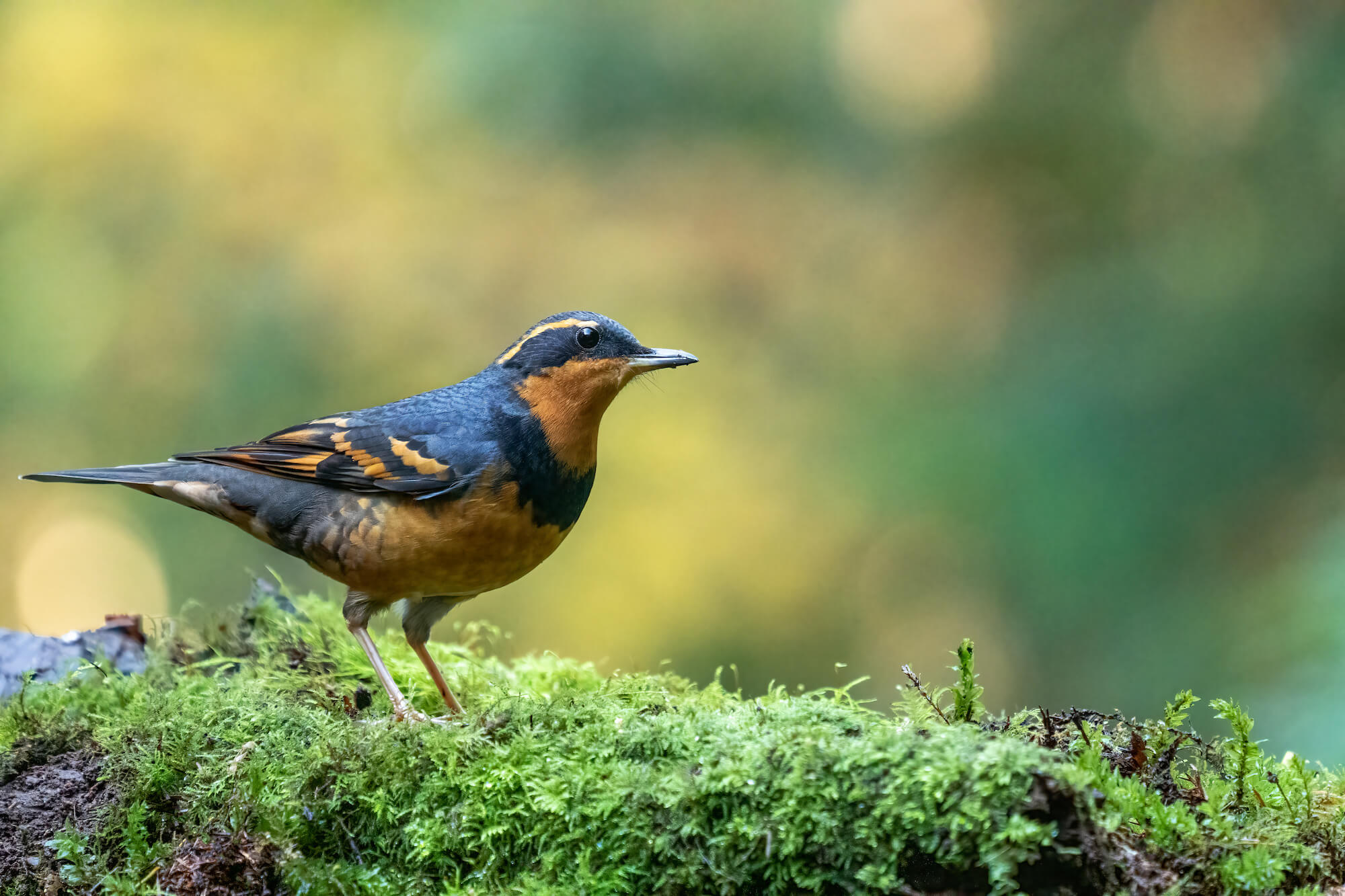
A varied thrush first showed itself to me in the birch-spruce-cottonwood forests of Alaska’s Denali region. I was shocked by the bird’s handsome plumage, a mix of grayish blue, orange, and black unlike anything I’d seen. It remains among the most beautiful northern birds I’ve encountered. But in my part of the world, the varied thrust tends to be a shy, secretive inhabitant, far more often heard than seen. And then only for several weeks in spring and early summer.
Imagine my surprise and pleasure, then, to discover Ixoreus naevious is a common and highly visible bird of Oregon’s old-growth forest. The birds are everywhere, it seems, from the shoulders of gravel roads to the highest canopy. I’ve seen them more than any other bird here, and heard their alarm calls—a soft, whispered chut—even more frequently.
But their October songs seem to be sung only in the dusky hours when night passes into day. At least I’ve noticed their singing mainly between six and seven a.m., with their voices largely quieted by the time I head outdoors—no earlier than eight a.m. during a week when I’ve been saddled with a severe head and chest cold.
I’m not about to let a runny nose, wheezing cough, buckets of phlegm, and tired body stop me today. With only two full days remaining in my Andrews residency, I already sense a sort of urgency. That can be a good thing, as witnessed by my front-row seat on a downed and moss-blanketed five hundred-year-old Douglas fir (give or take several decades), while all around me varied thrushes sing in the day.
Maybe I’ve come to enjoy their trilling so much because varieds are among the earliest migrants to reach Anchorage each spring. Sometime in late April, they’ll join their voices with those of ruby-crowned kinglet, robin, and junco, early proof that winter is once more truly going to let go its half-year-long hold on the local landscape, even if snow stubbornly clings to the landscape.
There, too, the thrushes are early bird songsters, belting out their whistled, buzzy tunes before most humans have begun their daily routines. But the varieds are also late-night singers during Alaska’s vernal season, while here I haven’t noticed their voices at day’s twilight end.
Continue reading Sherwonit’s “Reflections on Thrush Songs, Newt Tracks and Old-Growth Stands of Trees.“