The Last Anthropangaeans
Carl Jung once made a prophecy…Americans, he said, will finally become Indians, natives of their place. If they don’t, they will die and their place will die.
Kim Stafford (Having Everything Right)
Outside the window, wet feathery Cascade Mountain snowflakes fall from an overcast January sky. Inside by the woodstove, a brittle stalk of dried stinging nettle (Urtica dioica) crackles as I split it lengthwise to peel out the inner pith; the first step in preparing the outer fibers for twining into cordage. This stalk is one of several dozen specimens gathered from a small, wild patch growing in a wetland not far from my house and has been drying since mid-September.
Here in the Pacific Northwest, stinging nettle is, like me, of European origin. Prior to its arrival, cordage of comparable quality was often derived from various species of dogbane (genus Apocynum) as well as fireweed (Chamaenerion augustifolium) and western red cedar (Thuja plicata).
Local field guides condemn stinging nettle as a highly invasive species capable of overwhelming the native flora. The conventional narrative frames the situation in terms of brutal competition, with beleaguered botanical old-timers falling before the onslaught of a horde of vascular Vikings.
Reputation notwithstanding, the nettle population in the local patch has not lived up to the analogy, but is intermingled with thriving native horsetail (Equisetum arvense), bracken fern (Pteridium aquilinum), and trailing blackberry (Rubus ursinus) as well as other non-native species such as Himalayan blackberry (Rubus armeniacus), St. John’s wort (Hypericum perforatum), and Scotch broom (Cytisus scoparius). These latter three rate high on the local eradication hit-list.
However, by taking a longer view of not only the wetland, but of post-colonial landscapes all across the Earth, a different interpretation arises.
The unprecedented mix of species represent nascent ecosystems in the early stages of working themselves into something increasingly stable and lasting. That the vast majority of the planet’s surface has been brought to a similar state of tumultuous transitional reconfiguration all at once creates an overall perception of wholesale biotic intrusion and devastation. But it’s happened before, most notably, the last time all of Earth’s continents collided, about 335 million years ago, resulting in the formation of Pangaea.
And now it’s happened again.
Only this time, the joining of land masses has occurred not as a result of tectonic movements. It has occurred as a result of human movements. Elizabeth Kolbert called the result New Pangaea in her book The Sixth Extinction. I call it Anthropangaea.
And Anthropangaea is where all of us now live thanks to the technological tethers that have, in effect, drawn the planet’s continents together once again. The resultant intermingling of plants and animals has produced unprecedented floral and faunal compositions of sufficient uniqueness in many places to represent no less than instances of ecosystemic origination.
***
My ancestors became Anthropangaeans millennia ago, when some long-gone inhabitant culture of northern Europe (whose members may have gathered nettle there) was swept over by an earlier front of the same conquering wave that swept into North America post-1492. I’m a child of the totally assimilated, of those who survived in body by joining the wave, becoming a part of the sweep, and forgetting who they were before, then passing the amnesia on and on, right down to the present.
This amnesia has been compounded personally by repeated dislocations as an Air Force brat who lived in seven different places (Colorado, West Virginia, Maryland, Florida, Alabama, Alaska, and South Australia) by the age of ten. Arrival in the western Oregon Cascades at age nineteen put a stop to my wandering. The deep coniferous forest, misty waterfalls, subalpine meadows, and glaciated peaks held me fast. And I settled in.
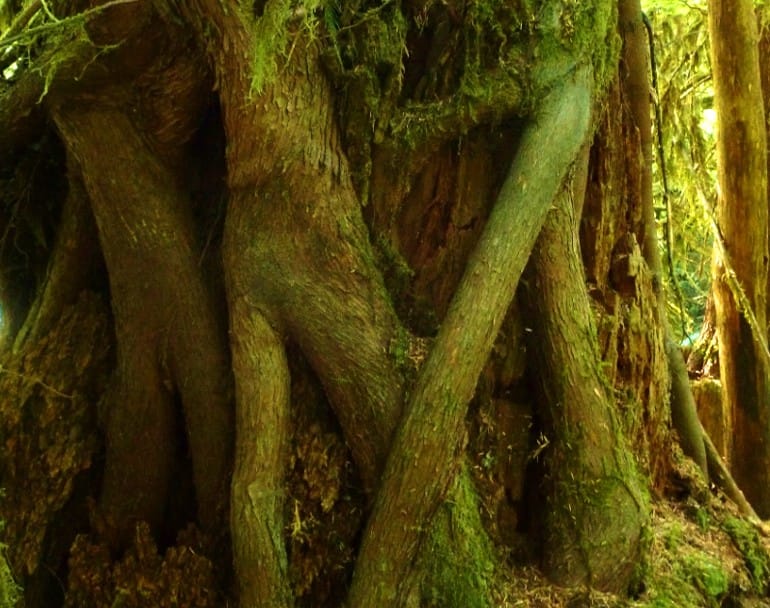
At first, everything felt right. Then I began to fill with the memories of these mountains, mountains that were part of the territory of the Molalla, a people who were swept to the reservations in the mid-1800s thereby creating a vacuum of seemingly empty lands. I came to live with my family on four acres of those lands in the McKenzie River Valley. None of our ancestors lived here. Primeval forest stood in place of our house until well into the 20th century—a few enormous Douglas fir stumps can still be found tucked among the second growth, obscured by vine maple thickets and overgrown with hemlocks and red cedars whose now-exposed roots seem to be straining to reach solid ground before the rotting stumps completely crumble away beneath them.
And the more I learned about this land, the more I felt like those hemlocks and cedars, except without the supporting stumps or the sense that there was any solid ground to reach. In the search for footing, I sought to understand my place in the broadest sense, by stepping back and following the intercontinental movements of humanity over the Earth, beginning with the long process by which every land mass outside of Africa came to feel the pad of human feet for the first time as our ancient ancestors dispersed across the planet.
From this time-lapsed, high-altitude vantage, a pattern emerged. In essence, dispersal-era sapiens were engaged in a process of substitution, of substituting themselves and everything they brought with them for all the forms of life that fled or fell to make way for them as they wedged into the many new lands where they spread. Lands already full.
With each replacement, the burden of responsibility they bore for those lands grew. Thus, the act of coming into ecologically-refined and previously-unpeopled places, changing those places and being changed by them, bound the new arrivals to the places. It made the people indigenous and shaped their very identities, lending credence to the common indigenous view found throughout Asia, Europe, Australia, and the Americas of ultimate origination not in Africa, but in local homelands.
Here in the Cascades, such a story likely informed the Molalla. And truly, they did not come into existence until their ancestors entered this landscape, came to embody it, and carried the tradition of that embodiment across generations for untold centuries, if not millennia—time immemorial i.e., time beyond memory. Before that, the Molalla literally did not exist anywhere. The same can be said of any indigenous culture with a multi-generational tradition of integration into a place.
As a beneficiary of the movements of my colonial ancestors, acknowledgement of the violence and atrocity underlying the circumstance of my birth in North America produces a feeling akin to survivor’s guilt, only at an existential scale. Especially in light of all the cultures, like the Molalla, who responded to the filling of Earth’s human habitat not by turning to conquest in order to continue traditions of dispersal-era expansion, but by staying put and integrating themselves into the eternal cycles of their homelands long enough to reach time immemorial.
I know what has happened to many of these cultures and their homelands to account for my presence here now. The balance due on that account seems unpayable. So, the question is, given all that has transpired, what, if any, recourse remains for the inheritors of conquest to change our ways?
***
As I finish depithing the nettle and start twining the long, strong fibers into cordage, an unexpected answer presents itself.
By recognizing the wildness of the nettle in the nearby wetland rather than focusing on its place of evolutionary origin, I can accept its local authenticity. The same acceptance for myself depends on acknowledging a kind of heritage traced not through chromosomal genealogies or Old-World culture, but through the land where I am in this moment. A new identity then becomes possible, a Cascadian identity, unique and original, though not without forebears.
After all, humans—members of my species—have prospered in the McKenzie River Valley, in the shadows of everything from erupting volcanoes to old growth forests, for at least ten millennia and likely much longer. Those humans are my predecessors in place. But rather than falsely recognize them as ancestors, a different conceptualization of kinship is required, a conceptualization derived from shared locale rather than shared blood. I call it landcestry.
Through the landcestral lens, I acknowledge place-based kinship ties to the people who preceded me in these mountains. And by simply living here, I am their landescendant. Thus, I have a responsibility to honor this land, to be a good landcestor in my turn, just like everyone does in relation to wherever they are, even if, like me, they are a recent arrival.
To be clear, landcestry is not about attempting to adopt the same relationship with the land as those who came before. It’s not about trying to fabricate indigeneity by co-opting the cultural practices of others, or living in a past that no longer exists, or could even be restored. Climate change, mass extinction—both biological and cultural—and countless other Anthropangaean upheavals have seen to that.
Landcestry is about recognizing how, despite millennia of increasingly rapid, profound, and in many cases irreversible socio-ecological degradation, fragmentation, and displacement, there is a deeper continuity, even now, twining us all together. By drawing inspiration from this continuity, we stand a far better chance of finding ecologically sound and spiritually inclusive landscape relationships and practices appropriate to the places where we are in the present moment than we do if we continue to root our identities in bloodlines, traditions, and memories from far off elsewheres and long ago elsewhens.
In this light, Jung’s prophecy applies not just to Americans, but to everyone on Earth in relation to the places where they live. It even applies to many indigenous peoples. I had not considered this fact until Chickasaw author Linda Hogan pointed out in a conversation how a great many of the world’s contemporary indigenous peoples, whose ancestors were forcibly removed from their homelands, prohibited from engaging in traditional cultural practices—including the speaking of their native languages—and relocated hundreds if not thousands of miles away, might also benefit from the concept of landcestry.
As a linguistic tool for healing rifts between not only humans and the lands where we live, but between the descendants of myriad human cultures who must share these lands, landcestry seems ideally suited. It literally emphasizes our common ground rather than our differences. And when I think of all the bloody conflicts in the world being fought over land, I wonder how this concept might help bring resolution to many of them.
It has certainly helped me resolve the struggle I have felt for so long; now, no matter where I am or how long I’ve been there, I feel more physically, conceptually, and spiritually rooted and alive than before.
Just in time for Anthropangaea’s break-up. And the explosion of life poised to follow.
Making cordage from wild nettles growing in the western Oregon Cascades feels like a human way to be a part of it.