Writings
Note: These are pieces of writing extracted from Vicki’s journal and hand written on 2.75″ X 4.25″ sheets of paper held together by a clothespin. They have not yet been assembled into poems.
To call down an owl:
Four notes, rich, melodious.
And then, a four note response.
Forest music.
How incongruous the little white mouse
on the branch – nose twitching, exploring
first one direction, then the other.
Frail. Frightened. It was a relief
when the owl took it –
the tension broken by a silent, velvety glide,
a quick sweep of wings.
Log decomposition site: a circle
of old growth and moss. A forest room
where silence is tangible, enfolding,
as though the bark and moss
have absorbed hundreds of years
of bird calls, animal cries, human voices –
absorbed the sounds of a tree falling,
a twig snapping, an insect’s wing drifting
to the forest floor – absorbed all of the sounds
of the forest and now fills the silence with them.
To stay here. To be next to log number 209,
to let moss cover me.
Lay me here when I die
I say to the tallest fir. Here I will be tiny
as the fine threads that hold the star flower aloft,
tiny as the red caps of lichen,
tiny as the swordfern’s spore.
To sleep. And not to name.
But my mind continues to catalogue:
pipsissewa. wild ginger. anemone.
vanilla leaf. And my eyes trace
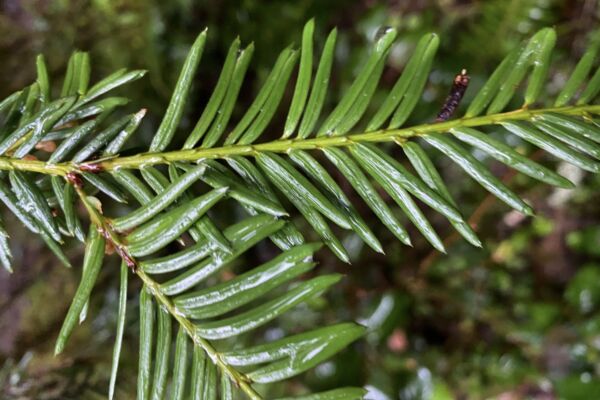
the red coals of the yew tree
where the bark peels back. Taxis brevifolia.
I learn to live with loss.
A yew tree could not have saved him.
Debris: from the French, debriser, to break into pieces.
A creek stone. A curl of moss. A thread of lichen.
A spotted owl. A coral root. Log jam. Earthflow.
A cedar splitting in half as the crack in the earth widens.
A watershed broken into pieces – by scientists, by soil organisms, by
the mycorrhizae mats that extract nitrogen and phosphorous.
Geologist. Hydrologist. Saprophyte. Raptor. Specialists.
The debris of the watershed, the debris of science:
a continuous unweaving of fragments.
To break apart is one way to learn.
To put back together is another.
Gravel bar: a deep thunk thunk thunk
of water on rock – a tone deeper
than the heartbeat of a boulder –
reverberating, a bass line
under the splash and cymbal crash
of white water.
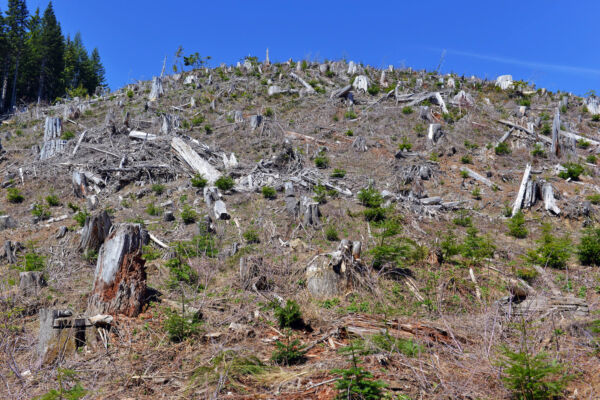
Clearcut: a wealth of brush.
Vine maple, hazel, alder, willow,
broom, bracken, iris, daisy,
blackberry. The young firs
rise like fountains through the brush,
the tips of their branches heavy
with new growth.
Here, it is not the earth
that is naked,
but the trees left standing,
trunks bare to the crown.
This first flush of new growth
is glorious.
Later, when the brush is removed
and the new firs grow thick
and tall, the silence of monoculture
will fall over the land.
But now, this hillside sings.
The gravel bar: intricate patterns
of stone. Perfectly composed
without the symmetry of flower
or cone. Like a haiku, the stones
of the creek are arranged
on a different model from the sonnet.
Is any one here studying taste or smell?
Recording the flavors of snow melt or creek water in spring?
The smell of a four hundred year old fir newly fallen?
Or sound? What can the wind tell us of the shape
of the land, the shape of the needles that serve it?
The wild: bird and tree. Creek and stone.
When Nichole called down the Lower Browder male,
something in me changed.
I felt solemn as I watched the owl –
and humble as he watched me.
And large and clumsy and out of place.
And insignificant.
The owl and the calypso orchid were at home
intricately adapted to a particular place –
the orchard dependent on mycorrhizae,
the owl on old growth.
In two hundred years, this forest, this “experiment,” won’t stop.
Some one will still be here looking at coral root, tasting water, listening to a
thrush, watching stones. Peter is dead and time has stopped for him. But we are
alive and the world keeps changing. Here, in this forest, the changes make sense –
the falling of a Douglas-fir is not a disaster; it is part of
the whole. And the hemlocks and rhodendrons and ferns take root, grow on the
fallen tree. Out there, beyond the boundary of the Andrews,
change doesn’t always make sense. So few things retain their connection to the
earth. And a death – the death of a brother – is a personal thing.
Out there, we have compartmentalized time and change and death,
cut it up into private segments the way we have cut up the land.
Here, everything belongs to everything else. Nothing is isolated, nothing
is owned. And what dies stores the elements necessary for
new life.
A fir locks time. A creek
releases it. And a stone?
Scoured by water, ground round
by knocking on other stones,
colonized by lichen, grain by grain,
a stone wears down.
Each site has its own colours, sounds, textures, smells.
Each site has its own time.
Outside the forest, time changes, returns to the tempo of the twenty-first century. In
the forest we are returned to earth time –
creek time, forest time, moss time, stone time, yew time, coral root time.
X X X
One week. And since I arrived, the weather has changed dramatically.
The moon has grown to a crescent. I have seen a spotted owl. Watched a creek. Walked
in old growth forest. Sat next to a decomposing log. I have thought about time and
death. About words and silence. I am not the same person
I was when I turned off highway 126 and drove up to the Andrews forest.
Two hundred years is a long time. I’m beginning to believe we will make it.