Poems from the Andrews Forest

The Path to Lookout Creek
is a quick succession of green things,
the best of which is vanilla leaf,
its triumvirate leaves like some beast’s
triptych eyes. Look it straight on
and you’ll probably lose your sight—
beauty like that, you’re not used to
in Spokane where now the last
of the season’s flowers crumple
into greasy shop rags, the water
plunks out from under the rocks
and flows like your father’s coffee
into its next orifice. But here—yes,
that’s the drop of pine needles
your ears pick up, and that, the stumble
of creek, and this, the branches stirred
just enough by wind to make you miss
the spider gliding down his thread
until he’s just in front of your lips. Go
ahead, kiss him, just to see what happens.
You were always afraid to do it
with those boys in high school,
the ones whose bodies dragged yours
around by the skin. Who knows where
those boys are now. Who cares? A doe
is here with her twin fawns, and they seem
to know how ridiculous you are, look
at you like you mean nothing,
your camera held up to capture them,
lips extended toward a narrow string.
On Assignment in the H.J. Andrews, The Poet Thinks of Her Ovaries
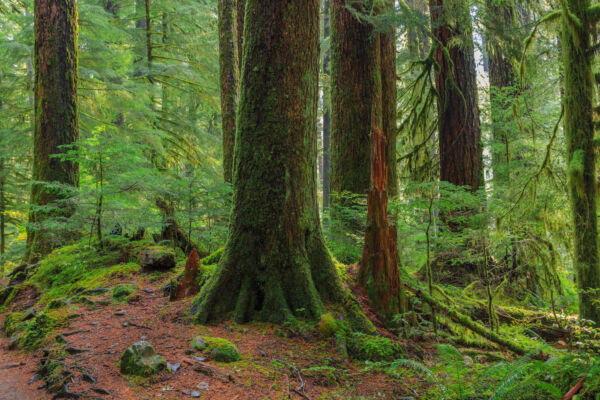
hiking the Old Growth Trail
From the base of a Douglas fir, the forest
management guru is saying important things:
words like biodiversity and water quality,
but I can’t help listening to that water, the birds,
buzzing insects, the silence the trees make,
light through their needles. Or the silence is you,
and I am the trees, making you, spinning you out
into this perfect golden air. Here, I am thinking
of you, ten years old, how you’d be playing
in the creek, letting its shadows weave
through your toes, its minnows instruct
your next move. But now, you are unformed,
an egg, the sperm that will start you tumbling
back in Spokane, the man who will be your father
with his quiet pulse. I’m thinking of you still,
the way you are the light passing through
the hemlock, the way you warm it,
coach it to accept the moss,
make your way to its belly, the way it lives
because you live.
Some Thoughts on Rot
-Log Decomposition Plot, H.J. Andrews Forest
Not fallen soldiers, not sleeping
giants, not long green caterpillars.
Not tombstones rising from them,
not broken teeth or the bulge-bright
eyes they’ve let pop from sockets
like a cartoon inspector
to watch us with. How strange
our human need to make these human,
these hemlock and fir and anonymous
logs, laid here with white buckets
to measure how they breathe.
But breathe isn’t right, either—
its something we do, isn’t it, our alarmed
inhale when a cone drops
with no intent other than the perpetuance
of a species, our mantra of life
we take for granted
every day while we force the earth
into imitation. These logs
have no concept of us. No concept
of self. They just are, just respirate,
carbon dioxide being processed. We need
these logs, we’ll keep needing them, even
after we’re inert and useless, even after we’re dead.
Like the Shell
You can’t tell me I don’t want to stay here
where the little pine needles are soft
the way the larger needles will never be again. Both
are the color of rust when weathered, one
in stacks by stands of fir and vine maple
is plush as a bed. Let’s lie down in it
awhile; these red winged ants will fly away.
The sun has me tucked in its earth shoulder,
the creek is moving, the wind knocks lung
lettuce down from its threshold in the canopy.
We aren’t yet at the beach, but I
can smell the beach—nearly—
its dune grass making the same sound
as water over rocks, or the whir of a fan.
After all, couldn’t we also be in a living room,
our floor unvacuumed as if we were hermits
living in the forest? In science class
I misheard the professor when she said hard shell.
For a long time, I thought the hermit
crab was born without a heart shell, and I pictured
it flitting about the sand, its heart
vulnerable, every gull eye on it while it scuttled
for the safety of those swishy
anemones. Our species is lucky to have a ribcage,
a thing we can decide to lay
against the earth, where two of us fit
sweetly into the same groove of these roots.
You the bone-like miser, I your soft thud of meat.
Fritillaries, Carpenter Mountain Mosaic
*
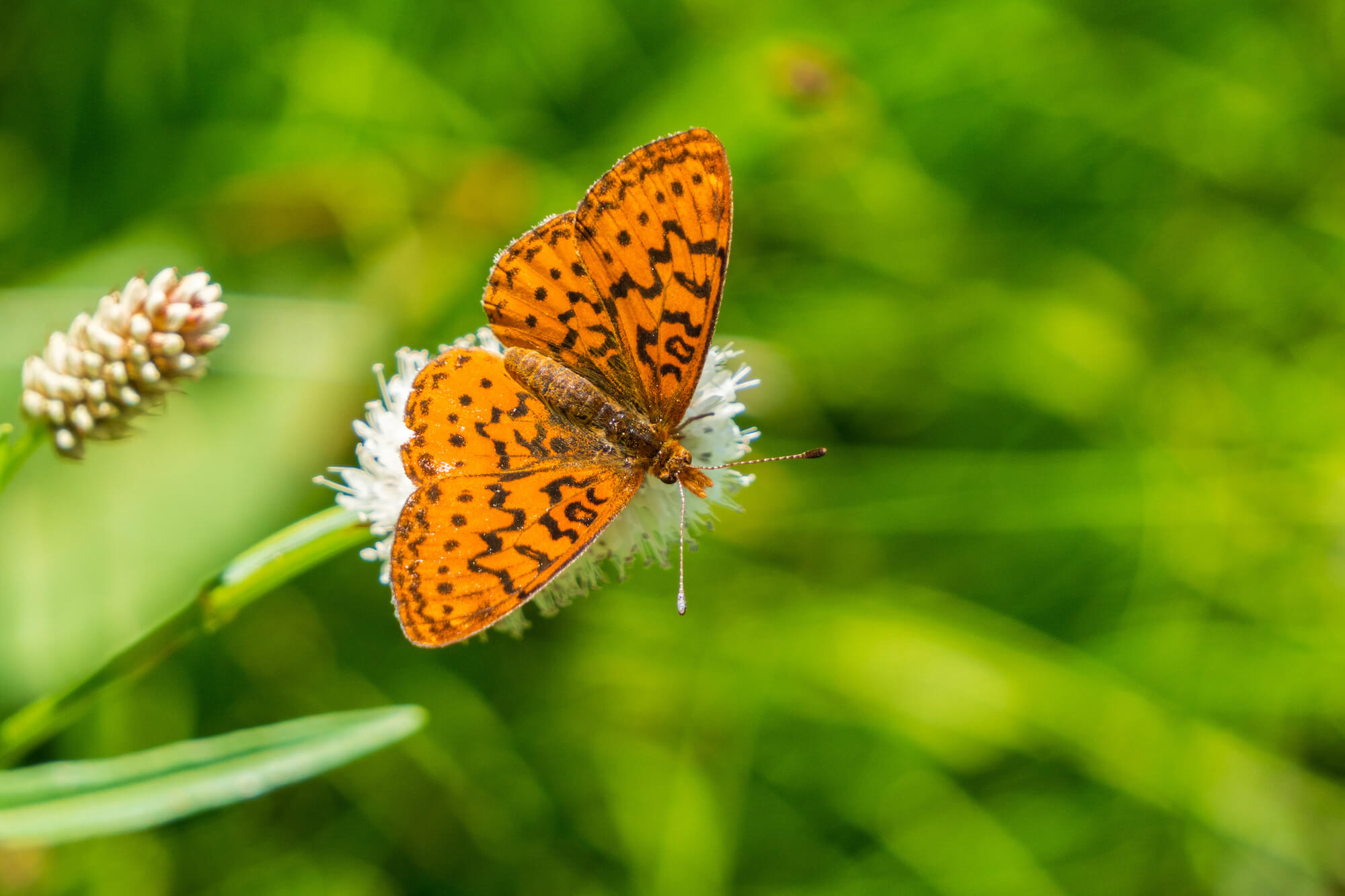
These fritillaries scatter
like tangerine rinds
over the yellow meadow flowers.
My fingers want to peel them down
to the hurt they must have under—
or is hurt a human thing?
I am not hurt, nor yellow,
nor a fritillary flitting
from here to there.
*
Fritillary: claw-less, soft
orange wings. Flit—self—
light. A candle glow
on these Northern
goldenrods
which lure them
like lamps in a dark
lit street, the wet
coming out of the dark
in little flames.
*
You are talking to
the Northern goldenrod
with your little antennae
saying things in butterfly.
*
An orange dalmation
descends the stalk
on its way to become the fire
of the meadow,
dice-box, furry wing
feet.
*
Where are you,
fritillary,
among these lights
like flowers?
My lights are northern
goldenrods sparring
the dark
rocky meadow.
*
The color yellow is lit by you,
the color green shakes itself
down
or up from these flakes of basalt,
andesite cracking itself
around your roots like a necklace.